Tuesday, 24 March 2015

Beer Ticking


I am certain that most beer lovers will have come across so-called “tickers” at some stage in their drinking careers, but for the un-initiated, “Beer ticking” is the practice of keeping your own recorded history of every different beer that passes your lips. It’s a simple pursuit, rather like train spotting or stamp collecting, but infinitely more pleasurable." Or is it?

As with anything in life when a pleasure turns into an obsession, or even an addiction, then it surely is no longer a pleasure. Most open-minded beer drinkers like to sample something new now and again, and this particularly applies when visiting a different part of the country or somewhere overseas. Part of the joy of visiting beer festivals is to do just that; pick out a few beers which catch your interest or you may have read about before and see what they are really like.

However, there are groups of individuals who go along to festivals with the sole aim of only sampling beers they have never tried before. How do they know they haven’t drank these beers before, I hear you ask? Well they keep lists; often incredibly long and detailed lists, the like of which would not be out of place in a catalogue of museum artefacts.
 
If you don’t believe me, read what one ticking, or scooping"  website has to say on the matter "What is scooping/ticking/beer bashing? Basically, it is the drinking - and more importantly the writing down - of all "new" beers drunk; all beers thus "scooped" are put onto a master list (either paper based or, more commonly in these technological days, onto a PDF or suchlike) which can be well over 10,000 different beers in total, and the scooper carries this around with him to ascertain if any beers he encounters on his travels are "required" by him.”

As I said at the beginning, I’m sure we have all encountered such people over the years, but a couple of years ago I was reminded of "ticking" when I bumped into a character I know at the White Cliffs Winter Ale Festival, down in DoverI won't reveal his real name, in case he's reading this blog, so let's call him Norman. Now ever since I first knew him I realised Norman was an inveterate ticker of beers, but it wasn't until my conversation with him, at the festival, that I realised just how serious he was over his "hobby". 

Norman informed me of exactly how many beers at the festival he hadn’t tried and thus needed to tick or "scoop". I wasn’t really interested and even though my glazed over expression might have conveyed this to a normal person; Norman carried on, oblivious to my increasing boredom and was soon in full swing. It was almost as though I wasn’t there as he continued giving me chapter and verse about his hobby/obsession.  Apparently the Holy Grail of beer ticking is the Egham Beer Festival, held at the town’s United Services Club. The club runs three festivals each year and prides itself on sourcing beers which are either new, or which are or limited in their availability.

Proof of this can be found on the festival website, where the following comment sums it all up. “We cannot think where one would find so many tickers to meet at one time as at Egham. We have just spent three very enjoyable days at Egham and have met so many Scoopgen scoopers from all over the country each day.”

Now you or I could probably turn up at any beer festival up and down the country and find plenty of beers we hadn’t sampled before, and with the massive increase in brewery numbers over the last four to five years, no doubt there would be breweries which we would not have heard of either. We would be pleased with this and would enjoy sampling a few of these new beers, along with renewing our acquaintance with a few old favourites. Not so your ticker. Armed with his notebook and master list he, and it is invariably the male of the species, will approach the event with military precision.

This brings us nicely back to Norman and his obsession with “ticking” new beers. I had known him through his involvement with my local CAMRA branch, and back in the days when I had my own off-licence, I remember him popping  in from time to time to see if I had any unusual bottled beers in stock (BCA's naturally).  

On more than one occasion I was able to assist him with his quest, and as a show of gratitude on his part, he presented me a weighty hand-bound tome produced by an organisation calling itself the Guild of British Beer Samplers or GOBBS* for short. This was a real anorak's bible, as not only did it purport to list every cask ale available in the country, but it included many that were no longer available. It even went as far to include special "one-off" brews, and listed separately many beers where there had been tweaks to the recipe or a slight change in gravity. In short whilst it was incredibly anal, someone, at some stage, must have sat down and compiled all this (useless?) information

I thanked Norman for this gift, even though it turned out to be an edition which had just been superseded, whilst at the same time wondering what use such a publication would ever be to me. Now don't get me wrong I am as interested in new breweries and new beers as the next beer enthusiast, but not to the in-depth analysis afforded by this publication.

Compared to some in the “ticking” community, local man “Norman” is a mere amateur. An article on “beer ticking”, published in the Publican Magazine in 2008, featured an interview with Birmingham based “Mick the Tick” who, back then claimed to have tasted 33,000 different beers. His friend, Brian ‘The Whippet’ Moore, beat this score, with a phenomenal 40,000 ticks.

For Mick, what started out in 1975 as a quest to visit every pub in a local guide, whilst on holiday in the Isle of Wight, turned into a full-blown obsession when his long-suffering wife bought him a copy of the CAMRA Good Beer Guide. “I saw the list of beers in the back and thought I’d try to drink as many as I could,” says Mick, who had dabbled in train spotting and plane spotting as a teenager “before women came along.”

Now I don’t know whether either of these characters are still with us, as given the amount of beer they must have shifted over the years (even if it is all half pints), one could be forgiven for thinking their livers, and other vital organs, might not  be in the best of states. But for a further insight into this strangely obsessive fraternity, look out for a film made in 2010, entitled “BEERTICKERS: beyond the ale.” You can see a trailer from the film on this Youtube link.
 
As ticking grew with the growth of micro brewing and the increasing numbers of beers., some tickers started “bottling” beers so they could scoop many more than they could drink on the spot; taking them away to consume later. The kit required for this is some empty 250ml plastic pop bottles, a funnel – for transferring the beer from the glass to the bottle, and some labels.

Some tickers think bottling is "cheating" as it means an end to "capacity" limits at beer festivals, but others take things a stage further by forming “bottling cartels”. This involves a group of tickers getting together and deciding to bottle for each other. Each member of the cartel would then go to a different festival, or city, and bottle beers on behalf of other members. They would then arrange to meet up, as soon as possible, for a “bottle swap”.

Final word (for now), on the subject.


How to spot a ticker in your local pub


Appears during the day


Arrives on a bus


Arrives with a rucksack/trolley


Brings Panda Pops bottles (or similar) plus funnel


Studies full range of cask beers before ordering


Drinks halves


Makes notes

 *GOBBS stands for Guild of British Beer Samplers, a tickers’ organisation formed in the late 1980s. It exists mainly to produce the GOBBS Guide, which aims to list every cask beer in the country.

Sunday, 22 March 2015

Bargain Beer at M & S


It was bargain-basement time this weekend at our local Marks & Spencer, with a couple of slow-moving beer lines being sold off cheap. On Saturday I picked up a few bottles of M&S Orange Barley Beer; a 5.5% offering from Batemans of Wainfleet. Priced at just 90p per 330ml bottle this beer was a bargain which was too good to miss. The company claim “The beer is infused with bitter Seville oranges to create a fantastically fragrant and zesty full-bodied tipple that pairs beautifully with chocolate puddings.”

Also reduced to sell was M&S Norfolk Nip Barley Wine7.0% from Woodfordes. Priced at £1.40 a bottle, this beer represented another bargain, and even if the shelf life on this beer is short-dated, I purchased a number of bottles for laying down. According to the bottle the beer is “Brewed for us by Woodforde’s Broadland Brewery in Norfolk to an original recipe from 1929, this classic English beer blends roasted East Anglian barley and Maris Otter pale, crystal and chocolate malted barley with Goldings hops.”

They will come into their own, come the autumn, although it’s been so cold these past few days that I’m sorely tempted to crack open a bottle later tonight!
 
I don’t know if these reductions are unique to the Tunbridge Wells store, or whether they apply nationally, but if you are a fan of either of these two beers, or you fancy looking out for other bargains, then get yourselves down to your local Marks and Sparks.

European Beer Bloggers & Writers Conference 2015 - Excursions


In my recent post about the European Beer Bloggers & Writers Conference I mentioned that I had also booked a place on the pre-conference trip, and also the two-day post-conference trip. Details of both trips have now been made available, so I thought I’d share a few of the highlights with you.

The pre-conference excursion, which departs from central Brussels on Thursday, August 27th, has been arranged by the Belgian Family Brewers Association; a not for profit association of Belgian breweries which have been brewing beer for at least 50 years non-stop. There are currently 21 members  representing 15% of Belgian brewers who, between them, amass a total of more than 3,500 years of tradition and experience in brewing.  

The  excursion includes lunch, dinner, and of course, beer, plus transportation to and from the Conference Hotel and everywhere in between. It is intriguingly themed:  "Oak, Fruit, Hops and More; Where Innovation Meets Tradition", so I’m guessing this entails fermentation or maturation in oak vessels; fruit (frambozen or kriek); a possible visit to a Belgian hop garden plus something extra.

According to the itinerary, the first stop is Diepensteyn castle; a once run-down castle which is now owned by  the PALM Brewery and restored to its former historical splendour. It is situated close to the village of  Steenhuffel.  Hops will be the main subject of this visit and should serve as the first inspirational item on the tour which is described as helping attendees to learn about speciality Belgium beers.

The second stop is at Lindemans Brewery in in the hamlet of Vlezenbeek, in the heart of Pajottenland. .  Head brewer, Peter Renders, will explain the centuries old tradition of spontaneous fermentation and its role in Belgian brewing. He will also talk about the role of FRUIT in the brewing process. “Peter Renders has been brewing lambic for 13 years.  His father also worked at Lindemans, and during his 52-year career, he helped make the brewery into what it is today”

The third visit of the day takes EBBC delegates to the beautiful Dupont Brewery, where “MORE beer secrets will be shared with the blogging community.”

The final stop on this full day beer tour is at the Dubuisson Brewery, the oldest brewery in Wallonia.   A discussion of the role of wood, and especially oak, in beer at Dubuisson will illustrate one of the more complex elements separating good, specialty beer from the rest…
 
Maturation vats at Rodenbach
If anything the two-day Post-Conference Excursion, with an over-night stay in Bruges, is even more exciting as we travel  through West-Flanders and dive deep into the brewery and hop culture of the region around Poperinge. According to the write-up, tour participants will revel in the hospitality of dinner at Rodenbach Brewery, where our palates will be enriched by the unique barrel-aged Flemish Red-Browns Ales produced there. We will meet personalities like Luc Vermeersch of Brewery De Leite who started brewing in 1997, in his small garden shed in Ruddervoorde, and spend some time with the brewer at De Plukker who operates a 100% organic production that started out as a hop-growing business before branching into brewing.  

Hop fields at Poperinge
We will get to know Bruges during a historical walking beer tour, which includes a visit to the Bruges Beer Museum in the heart of the city. We will also stop to meet the brewer of the quintessential Bourgogne des Flandres style at the nearly-finished new brewery in Bruges, which is going up within a stone’s throw of where the historic, Brewery Den Os originated.

The full itinerary for this two day beer adventure is as follows:

Transport to Poperinge
  • Guided tour of the visitor center, “Hopmuseum Poperinge”
  • A culinary “travel through the Westhoek” regional lunch at the Hopmuseum
Transport to brewery De Plukker in Poperinge
  • Brewery and hop growing tour + tasting with the brewer at De Plukker, a 100% organic production that started as a hop-growing business
Transfer to Westvleteren
  • Walking tour of the area surrounding Abbey of Sint Sixtus + tasting of Westvleteren ‘In de Vrede’.
Transfer to Oostvleteren
  • Meet the brewer at Struise Brouwers for a visit + tasting of this innovative microbrewery
Transfer to Roeselare
  • Dinner at Rodenbach Brewery and a visit with Plant Manager, Rudi Ghekiere. 
Transfer to Bruges for the night
  • Optional last beer of the night at Brugs Beertje
Day Two

9:30     Meet in Reception to start the day
  • Meet the brewer of Brewery Den Os for a very special preview tour of the still-being-constructed new Brewery Den Os brewery that produces the quintessential Bougogne des Flandres 
Walk to the Bruges Beer Museum
  • Historical Walking Tour of Bruges 
  • Visit Bruges Beer Museum in the heart of Bruges for an innovative approach to understanding the historical importance of beer + tasting
Transport to Ruddervoorde
  • Meet the brewer at Brewery De Leite for a vistiing + tasting in this newer microbrewery who’s founder, Luc Vermeersch, started his beer experiments in a small shed.
Transfer to Brussels
Like the pre-conference excursion, this overnight trip includes dining, transport, all visits and tastings, but also covers the cost of overnight lodging in Bruges. So what's not to like?


The renowned, but rare, Westvleteren Trappist Beer
With these excursions coming both before and after what, by its very nature, is bound to be a very beery bountiful conference, I am wondering if my liver will stand the pace! My wallet will be alright, as I have already paid for both the conference and the two excursions; it’s a question of whether my body can stand the pace!
Moderation will have to be the order of the day, but as most Belgian beers are notoriously strong; certainly by UK standards, and with such a wide variety being place in front of conference attendees, it will be extremely difficult not to succumb to temptation!

I have visited Brussels several times, and have also made two trips to Bruges, but despite this and the experience of 40 years seeking out and enjoying good and interesting beers, I feel that I have only scratched the surface of Belgium; despite it being a country renowned for its beers. The European Beer Bloggers & Writers Conference this August, plus the two excursions I have described above, should help redress the balance, and get me up to speed with this world famous brewing nation.


Saturday, 21 March 2015

Staying Local


When it comes to beer appreciation, and beer hunting, it is often all too easy to miss what it on one’s own door step. Last Thursday evening my local CAMRA branch held a mini-pub crawl which included two of the pubs nearest to my house, so the lad and I decided to join them. We had a good turnout for a mid-week meeting, and almost achieved double figures. This was pretty good for our branch, and for a cold mid-March evening was better than expected.

Vauxhall Inn
We started off at the Vauxhall Inn, a large Chef & Brewer outlet which has seen mixed fortunes over the years but which, at the present time, seems to be on the up. When I first move to Tonbridge, 30 years ago, the Vauxhall was a small, but attractive old weather boarded pub owned, as so many were locally at the time, by our old friends Whitbread. Being situated on the old London to Hastings road it was formerly a coaching inn, and the old stable block, which was originally a separate building, was incorporated into the main part of the pub when it was massively expanded back in the early 1990’s. Today’s Vauxhall is three times the size of the original, but it remains an atmospheric pub with plenty of character, particularly in the original part of the building.
 
There was welcoming log fire burning when my son and I arrived, but the rest of the group were sitting in a separate area the other side of the main fireplace. Two cask ales were on sale; Harvey’s Sussex Best and Vaux, a “house beer” brewed by Tonbridge Brewery, our local success story. Now I am not a huge fan of “house beers” as not only do they seem gimmicky to me, but they also seem something of a vanity project on behalf of the pub. A couple of my CAMRA colleagues agreed, and one remarked that you know full well that the beer is just the brewery’s bog-standard bitter, re-badged.

I wasn’t that keen on the beer, although I am normally quite a fan of Tonbridge Brewery products. Perhaps it was a dodgy cask, as it had a slight woodiness to it; either that or it hadn’t been looked after properly. My companions though confirmed that the Harvey’s was drinking well, so I suspect the former. There were quite a few people in the old part of the pub, but I couldn’t see how busy the dining area was, as it is sited on a lower level, but a pub like the Vauxhall is always going to appeal to the solidly middle-class inhabitants who live locally. An added bonus for those visiting the area is the adjacent Premier Inn; a throw-back to the pub’s days under Whitbread, but as both establishments are conveniently sited just off the southern end of the A21, Tonbridge bypass it makes a good base for exploring this attractive part of the Garden of England.

Primrose Inn
We moved on, just after 9pm, walking just a short distance down the road to another old weather boarded pub, the Primrose Inn. The Primrose is another former Whitbread pub, but whilst it has been knocked around considerably inside, it has not been extended externally, unlike the neighbouring Vauxhall.  It was fairly quite when we walked in, with just a few people sitting at the bar, although there was a darts match going on. Pub darts matches seem quite a rarity these days, although I know they must still take place, because a couple of my work colleagues are regular players for their local pub.

We found an alcove in the corner, adjacent to where the darts was taking place, but far enough away from the game so as not to be affected by it.  Harvey’s was the sole beer on, but it was in good condition. It was cosy and pleasant in the pub, but today’s Primrose is totally different from the pub I remember from when I first came to Tonbridge. This was back in the early 1980’s, when I was working in the town but living in Maidstone. Back then the Primrose was a traditional two-bar local, and myself plus a couple of co-workers would visit once a week for a lunchtime drink. This was back in the days when a “three-pint lunch" was both acceptable and quite normal. These days though, it would have me falling asleep at my desk!

We just stayed for the one, but the landlord thanked us when we left, no doubt glad of eight additional drinkers boosting his Thursday night cask sales. We had toyed with the idea of heading next to another former haunt of mine, but thought better of it, for reasons I will explain shortly.

Our next and final port of call was the Punch & Judy;arguably Tonbridge’s best surviving traditional pub, but in order to reach it we had to pass two other pubs. The first was the New Drum, tucked away down a side street called Lavender Hill, and a pub which has seen various changes of ownership as well as several different names over the years. Converted from two adjacent 19th Century cottages, the pub was originally known as the Drum, but when I first came to Tonbridge it had been “modernised” (gutted), and re-named the Victoria Tavern.

The new name didn’t last long, but it was a far better one than what it was called next! Some time in the early 1980’s a couple called Tom and Margaret bought the pub, and re-named it “Uncle Tom’s Cabin”. Fortunately this rather silly name was soon shortened by the locals to either “The Cabin”, or sometimes just “Tom’s”. The couple expanded the range of beers and the pub became a very pleasant place to drink in; attracting a youngish and slightly Bohemian crowd who I fitted in well with. By this time I had moved to Tonbridge and had adopted the pub as my local. The Sunday lunchtime sessions were not to be missed, with a meat raffle as an added attraction, but mainly it was the company of like-minded people which attracted me to the place. Most Sundays it was not unusual for me to stagger out of the pub at around 4pm, and whilst this might not appear out of the ordinary, one has to remember this was before all day opening came into force, and the Sunday lunchtime session was restricted by law to just two hours from midday to 2pm.

New Drum
As well as afternoon “lock-ins”, the Cabin was notorious for staying open long after the normal evening closing of 11pm. Customers sitting in the window seats were asked to draw the curtains, the house lights were dimmed and the door placed on the latch. Customers departing after this time were told to shut the door quietly and leave without disturbing the neighbours. I imagine the local constabulary were in full knowledge of this but, as there was never any trouble or rowdy behaviour, turned a blind eye.

Tom and Margaret sold the business, some time in the late 1980’s. Neither was getting any younger and Margaret was rumoured to be getting a bit too fond of the bottle – an obvious occupational hazard for publicans. Another elderly couple, Richard and Joan, bought the place and things continued in much the same vein. I continued to drink there until late 1991, when the birth of our son considerably curtailed my pub-going activities.
 
I’ve probably dwelled too long on this pub already, but since the mid 90’s, the pub has had a succession of owners, along with a change of name back to one which reflects its original one. Having been extended back and almost doubled in size, the New Drum promotes itself as a “sports bar”. If you like sport of every description, but especially football, shoved in your face from large TV screens mounted in every corner, then this is the pub for you. If you like a load of blokes in football shirts, ‘ffing and blinding then this is also your sort of pub; but it is not mine, and neither is it the pub most of my friends and colleagues enjoy either. Had it been a quiet night we might have been tempted to call in and sample the solitary remaining cask beer – Harvey’s. However, we knew from the Primrose that a EUFA Championship match was taking place so we thought the presence of eight strangers bursting in whilst the game was in full play might not have gone down too well. 

We therefore walked past the junction of Lavender Hill and then past the next junction where the second of the two “pubs to avoid” is situated. Like the Vauxhall, the Primrose and also the Punch, the Somerhill is another former Whitbread pub, but today, unless you like karaoke, loud music or again Sky Sports in you face it is somewhere best avoided. I won’t elaborate on its past history as, unlike the New Drum, it’s a pub I have never frequented all that much. It did go through a spell during the mid 90’s as a pub specialising in cask ales, when it was known as the Hooden Horse, but a succession of dodgy landlords, and equally dodgy owners inevitably led to it attracting the wrong crowd, and whilst it is nowhere near as bad as it once was, it is still not the type of pub I feel comfortable in.

Punch & Judy
The same cannot be said of the last pub on our walkabout, the Punch & Judy. With four cask ales on tap, including local favourites Harvey’s and Tonbridge, a welcoming log-burner, and a choice of different seating areas, the Punch ticked all the right boxes. We had another reason for wanting to visit the pub, as the Punch is hosting a beer festival over the Easter weekend, and we wanted to express our support. 

The pub was quite quiet for a Thursday, which meant we were spoilt for choice of somewhere to sit. We opted for the raised area at the rear of the pub, but not before availing ourselves of some beer. I opted for the well-hopped Black Sheep Best, whilst others, including our Scottish branch chairman, went for the Edinburgh Ale; a malt-driven beer from the Scottish capital’s Caledonian Brewery.

We stayed in the Punch until the landlord called “time”. With no other customers in the pub, he was probably keen on an early night. Before we left though, he gave us a copy of the beer list for the pub’s Easter Beer Festival. There are some interesting beers on the list, including one of my favourites; O’Hanlon’s Port Stout. I do feel though that the Punch will struggle to sell Fraoch; the heather ale from William’s Bros., but we will see.

The night proved an opportunity to visit a handful of local pubs which I normally wouldn’t bother with. What is interesting is they are all former Whitbread pubs, which just shows the monopoly this former Big Brewer had in the area.  Of the three, the Vauxhall came out best as a place for a quiet drink, but for a pub with something for everyone, well  that honour goes to the Punch & Judy.

Sunday, 15 March 2015

London Drinker Beer & Cider Festival 2015


I have to confess that London Drinker has never been my favourite beer festival. There’s nothing wrong with the beers; in fact the selection at this long running event is usually second to none. It’s the venue which I have the problem with.

Now I appreciate that the Camden Centre is an historic (art deco?), building and after talking to one of the festival stewards last Thursday, I realise it’s also one of the few original municipal buildings left within the borough, following its creation in 1965 from the amalgamation of the former metropolitan boroughs of Hampstead, Holborn and St Pancras. The problem I have is its size, and when London Drinker gets busy, as it invariably does, I feel hemmed in; a feeling enhanced by the lack of windows or other sources of natural light.

I had lost track of time when I left the festival last week, but I believe it was some time between 7.30 and 8.00pm, but the fact that people queuing outside were only being let in by the door staff in proportion to the numbers of people leaving is testament to the popularity of London Drinker, but also unfortunately serves to highlight the inadequacy of the Camden Centre as the venue for this festival.

OK, rant over. I was fortunate to have been offered a ticket to the Thursday afternoon “trade session” which was showcasing London-brewed beers. I arrived shortly after 3.30pm, having first called in at St Pancras station opposite to pick up my pre-booked Eurostar tickets for my Brussels trip, later in the year.

The hall was quite busy, but at that stage it was still possible to move around without having to squeeze past people. Only the London Beer Bar was open, although the bottle-conditioned bar did open later on. This was not a problem as it was beers from London’s burgeoning craft beer scene that I had come to try. Being a CAMRA festival, beers were naturally only available in cask form, but as this means of storage and dispense is properly handled, it still represents the very peak of the brewer’s art.

View from the balcony
I started with something light, in the form of an American Pale Ale from Clarence & Fredericks, and stayed with that particular style for a while, before graduating on to some of the more dangerous porters and imperial stouts, culminating in the 10.7% ABV Imperial Russian Stout from Fullers, which had been matured, in cask, for around 9 months. Boy it was good. Also good, but fortunately not as strong, was the 6.2% ABV Smokestack Porter from Tap East, who are based out in Stratford.

I met several beer Bloggers along with the odd brewer. I won’t name drop, but special mention should be made of Beer Viking, BryanB to whom I handed over the limited edition bottle of Guinness Night Porter which I had carefully brought back for him from last years EBBC in Dublin, and which I had been tempted to open on several occasions over the past nine months! I also met the legendary Jeffrey Bell; born-again beer blogger, former licensee of the Gunmakers Arms in Clerkenwell, and now landlord of the revived Victorian landmark pub, the Finborough Arms in Earl’s Court.

Girardin Kriek
I had already surmised from his revived blog Stonch’s Beer Blog, that Jeffrey is a great character, and so it proved. He introduced me to several people he knows in the trade, most of whose names escape me, apart from Steve Taylor who manages  “Mother Kelly’s Bottleshop& Taproom”, in Bethnal Green. I had read about this place on the It Comes in Pints blog, so it was good to meet up with Steve and enjoy a few beers with him. Mind you the bottle of Girardin Kriek he kindly shared with me was enough to finish me off for the evening!

Whilst in the company of BryanB, we shared one of the stand-up tables (converted barrels) with Fuller’s Director of Brewing, John Keeling and some members of his brewing team. This was great for a former home-brewer like me, to be in the presence of someone so knowledgeable and a person with over 40 years experience in the brewing industry. I obviously won’t divulge any trade secrets (not that we were told any), but what I did learn is that there is far more money to be made in the retail sector than there is in brewing; a fact borne out in my own industry of manufacturing dental materials.

So all in all it was a good festival, and a very pleasant way to spend a late Thursday afternoon/early evening. Thank you to everyone whose company I shared, and to those who bought me a drink. Special thanks too to the organisers of London Drinker for their hard work and dedication in keeping this festival, which is now in its 31st year at the same venue, running.

Saturday, 14 March 2015

The European Beer Bloggers & Writers Conference 2015


I’ve just booked my place for the fifth European Beer Bloggers & Writers Conference which  this year is taking place in Brussels on the 28th and 29th of August. This is now the second such conference to be held outside of the UK; a sign of the growing international interest from beer writers, and also a sign of the growing confidence and maturity of the American conference organisers, Zephyr Adventures. For me, this is my second Beer Bloggers’ Conference, after attending last year’s event in Dublin I’m really looking forward to it.

The choice of venue is an interesting one; obvious in many respects given that Brussels is the capital of a country famed the world over for having some of the most interesting and diverse styles of beer. Not quite so obvious, especially to outsiders, is the fact that Belgium is an artificial country with two quite distinct and very different linguistic and cultural communities, which are often at loggerheads with each other.

One thing which unites both communities is their love of beer; Belgium’s national drink. So whatever else you might think about the Belgians they certainly take their beer culture very seriously. I have to say though, that of all the capital cities I have visited over the years, Brussels remains my least favourite. I won’t go into the reasons why this should be here, but ask me again come the autumn as I’m looking forward to having my opinions changed as a result of my long weekend stopover in the city.

So what exactly takes place at the EBBC, and is it like many of my friends say, just an excuse for a piss-up? Well having now been to one of these events, I can safely say there will be more than a few beers drunk over the course of the conference. But looking at the agenda there’s also some serious, but still fun-sounding, stuff to do. For a start, it's a good opportunity to meet and befriend like minded people; people who you may already talk to regularly via social media, or even your own blog. Even better though is the chance to spend some time with them, enjoying a few beers together in a great pub in an unfamiliar town, exchanging information and generally getting to know people better.

The Beer Bloggers Conference therefore promises to be a festival of great beer, good food, great bars and cafés, and the chance to make useful contacts and new friends. Last year proved this and I see no reason why this year’s event should be any different.  

The conference takes place at the Hotel Marivaux , right in the centre of Brussels. For those thinking of attending, and for those who are just plain nosey, here’s the agenda. 

Friday, August 28th

11:30 – 1:00 PM Registration, Expo & Buffet Lunch hosted by Visit Belgium, featuring beers from twelve or more breweries.

1:15 – 1:30 PM Conference Opening.

1:30 – 2:30 PM History, Present, and Future of Brewing in Belgium with a panel of Belgian Brewers and industry leaders to be announced.

2:30 – 3:30 PM Finding Content Beyond the Beer Review - Are you stuck writing beer reviews? Research has shown consumers often are more interested in the backstory than an actual beer review. Hear from several successful writers about ideas for developing content.

3:45 – 4:45 PM Live Beer Blogging featuring ten or more different Belgian beers from the Belgian Family Brewers.

5:00  PM  Content (To be announced).

6:30 – 9:00 PM Dinner with the Belgian Family Brewers featuring twenty-two different beers –  The Belgian Family Brewers intend to welcome delegates into the family as they host the conference’s opening night dinner in Brussels.

9:00 – 11:00 PM Evening Café Crawl ending with private Belgian Family Brewers event featuring twenty-plus beers at the Delirium Café

Saturday, August 29th

10:00 – 11:00 AM Blogging with WordPress.com – (Details to follow)

11:00 – 12:00 AM Beer Marketing – How does beer blogging and writing fit in to the broader subject of beer marketing? Hear from a panel including industry marketing, public relations, and social media professionals.

12:00 – 1:45 PM A Walking Lunch, pairing Belgian Beers with Traditional Belgian Foods - Visit Flanders will host a moveable feast at the conference hotel. Food and Beer Stations will feature typical Belgian and Flemish foods paired with Belgian Beers produced in the Flanders region of Belgium.

2:00 – 3:00 PM State of Beer in Europe – Where does the beer industry stand now compared to where it was and what are the trends telling us? Hear from a panel of experts in the beer industry about the state of beer across Europe.

3:00 – 4:00 PM Content (To be announced).

4:00 – 5:00 PM Sour Beers - A scientific approach about how sour beers are brewed and aged. Making sours is science with a touch of magic and the presenters will tell you why. Presented by Petrus Sour Beers.
5:00 – 6:30 PM Pre-dinner Reception (To be announced)

6:30 – 9:00 PM End of Conference Dinner – Hosted by Pilsner Urquell who are long time friends and supporters of the conference. Held at the Hotel Marivaux.

A pre-conference excursion is available on Thursday, August 27th and post-conference excursion options start on Sunday, August 30th. I’m booked on both, and as there’s probably enough material just detailing what’s involved with these outings, I’ll be making a separate post about them a bit nearer the time.

In the meantime though, if you are anyway involved in the beer industry and fancy an interesting and fun-packed weekend in Brussels click on European Beer Bloggers & Writers Conference 2015.


Monday, 9 March 2015

A Bit Quiet at the Moment


I haven’t been blogging much recently, as I’ve had some rather sad family matters to attend to over the past 10 days or so.
 
On Thursday afternoon though, I’m planning to attend the Trade Session at London Drinker to do a spot of much needed catching up on the London beer scene. It will also provide some much needed light relief. In addition I’ve got a collection of Spanish beers to work my way through; souvenirs from our pre-Christmas trip to Barcelona.

We’ve also got a family meal planned for the weekend after next, at a rather interesting looking restaurant in Tunbridge Wells, which I'm looking forward to.

Will be back tapping on the keyboard soon. Paul.

Wednesday, 4 March 2015

Green Dragon - Wymondham


Green Dragon, Wymondham

After visiting one CAMRA National Inventory-listed pub the previous weekend, I hardly expected to visit another NI pub the following one. However, as luck would have it, I found myself calling in at the half-timbered Green Dragon in the picturesque Norfolk market town of Wymondham.

As I explained in the previous post, I was on my way to visit my ailing parents, and after a lengthy drive up the M11motorway and A11 trunk road, I was in need of what the Americans would call a “comfort stop”. I was also feeling a trifle peckish. I had taken the precaution of a quick peek at the Good Beer Guide before I left, and had marked either Wymondham or nearby Hethersett as suitable lunchtime stopping places. Both were within reasonable driving distance of my final destination, yet far enough away to make stopping worthwhile.
  
In the end I found myself driving into Wymondham after turning off the busy A11, having missed the junction for Hethersett. I made my way into the town centre, found a space in one of the municipal car parks and that all important “comfort station”.

Green Dragon
Suitably relieved I continued on foot into the main shopping street of this attractive market town, and soon found my way to Church Street and the attractive, Tudor-fronted Green Dragon. This wasn’t my first visit to Wymondham, as my eldest sister had lived in the town prior to her emigrating to America; but this was the first time I had been into the town centre and to the renowned Green Dragon.

The pub dates back to late 15th century although much of its exterior is Tudor and half-timbered with a dormer window. It was lucky to have survived only superficial damage in the great fire of 1615 and there are still scorch marks on external timbers. The interior retains some of the old features such as beams and mantelpiece. Today the Green Dragon pub has a bar and a little snug with wooden pew type furniture and a small dining area on one side. A much more detailed description of the pub, together with some professionally shot photos of the interior, can be found on the CAMRA National Inventory site.

The tiny & cosy snug
The pub was busy when I entered, with the right hand dining room completely full and the main bar likewise, but on enquiring at the bar, I was told there were still a couple of tables spare in the tiny snug. This was situated off a corridor, leading off to the left of the bar. Before disappearing to grab one of these tables I ordered myself a pint. Horizon from Lincolnshire brewers, Newby Wyke fitted the bill, after I ruled out Robinson’s Trooper and Moon Gazer Dark Mild, as at just 4.1% it was a beer I could enjoy without having to worry about my driving licence. I also ordered my lunch of battered cod and chips.

I like old pubs, especially ones like the Green Dragon which have been serving thirsty customers for hundreds of years. The snug was simply decorated and simply furnished with a timeless feel to it, but one thing bang up to date was the free Wi-Fi; an important feature which more and more pubs are now providing. Being on my own, and with the people sitting at the other tables all engrossed in their own conversations, a spot of web surfing helped pass the time until my food arrived.
"Moby & chips"

My lunch turned out to be a real “Moby and chips”, with the plate piled high. It was tasty, well-cooked and enjoyable and certainly sufficient set me up for the day. I only stayed for the one pint as I was keen to completer my journey following my lunchtime stop, but I am very pleased that I turned off the A11 and made the effort to find the historic and unspoilt Green Dragon.

Friday, 27 February 2015

Incommunicado


After last weekend’s beery excesses, this weekend looks set to be a pretty quiet one; perhaps even totally abstemious!

I’m off back up to Norfolk, to visit my parents. My mother is still languishing in hospital, although the medics are now looking at arranging some respite care for her, in a more suitable and quieter environment. Dad, with the help of the carers who visit thrice daily, seems to be coping alright.

The main news though is the eldest of my two sisters has flown over from her home in the United States, to spend a few weeks keeping an eye on mum and dad. She will be swapping the sub-zero temperatures, and deep snow, of an Ohio winter, for the more clement, but ever changing early spring of  Norfolk.

I will, of course, do my utmost to drag her down the local pub for a few bevies, as we’ve lots of news and happenings to catch up on. Failing that, I’ll get a few bottles in, and sup them in the peaceful surroundings of my parents’ bungalow.

One final point; there’s no Wi-Fi or other Broadband connection where I’m staying, so I’ll be a little out of touch with what else is going on. Probably not a bad thing??


Wednesday, 25 February 2015

Saturday 21st February Part Two: Three Rural Gems


As mentioned in the previous post, last Saturday a party of 24 volunteers who had helped a last October’s Spa Valley Railway Beer Festival, set off by mini-coach to present our longest established local brewery with a well-deserved certificate, after their Green Hop Ale was voted Beer of the Festival.

Waiting for opening time, outside the Queen's Arms
We visited three pubs over the course of the day; the Queen’s Arms, where the presentation took place, the Fountain at Cowden, where we had an excellent lunch and finally the classic and unspoilt Rock Inn at Chiddingstone Hoath. What follows is a description of the pubs, in an attempt to wet peoples’ appetites and tempt them into visiting these rural gems.

Described as a rare, rural time-warp pub, the Queen’s Arms at Cowden Pound was built in 1841, and is named after the Queen’s Royal West Kent Regiment. The pub has one of the last remaining totally unspoilt rural public bars dating from the Victorian era and which, apart from the paintwork, has been almost untouched since the end of the nineteenth century. The pub had been in the hands of the same family from 1913 to 2014, with the former landlady, Elsie Maynard taking over in 1973.

Much of the pub’s character was down to Elsie, who was born in the pub and until quite recently, when advancing years and declining health had forced her into a nursing home, had lived there all her life. Her mother had been the licensee before her, when the pub was universally known as “Annie’s”, and I understand that in some quarters it is still referred to as such.

Traditional Public Bar at the Queens Arms
Like many local CAMRA members, and indeed local drinkers, I have my own fond memories of the Queen’s Arms which stretch back many years, so what follows are my own observations of the pub. If you require a more detailed description, then this can be found on CAMRA’s National Inventory Site, along with some excellent photographs.

The Queen’s Arms has two bars; a traditional, no-nonsense public bar, and a larger saloon. The latter was rarely used, as all the activity took place in the public bar, which is on the right as one enters. It was a real old-fashioned public bar, of the sort which only we older drinkers can remember; lino on the floor, a plain wooden bar, an open fire in winter, and just the one draught beer. The latter had changed over the years. When I first knew the pub, it was tied to Whitbread and the beer was the long discontinued and much-missed Fremlins Bitter. After the Fremlins Brewery closed, Flowers Bitter was the replacement, but eventually Elsie ended up selling Adnams Bitter, although there may well have been a period when Brakspears Ordinary was the house beer.

Wot, no lager?
Like I mentioned earlier, there was just the one draught beer dispensed from a bank of three original, ebony-handled beer engines on the counter. Elsie didn’t hold with lager and didn’t sell it. According to legend she associated the beer with the Germans and two World Wars, but the real reason was its higher price compared to cask-ale. Nevertheless, she displayed a sign outside proclaiming “Lager Not Sold Here”; a policy supported at the time by many CAMRA members. Elsie didn’t sell alco-pops either and stocked a very limited range of soft drinks. Bags of crisps were kept in old-fashioned tins behind the bar, but she did provide food of sorts in the form of incredible value-for-money ploughman’s. These consisted of a substantial hunk of cheese, served with door-step thick slices of bread and optional, homemade pickles.

As Elsie’s health declined, the pub was looked after and run by a group of dedicated regulars, who were determined to keep though place as it was for as long as possible. By this stage, opening hours were restricted to weekday evenings, plus Sunday lunchtimes. Elsie would sometimes appear sitting on a stool behind the bar, taking everything in. She was quick-witted with a delightful sense of humour, and was one of the few people I know who spoke with a genuine Kentish accent, rather than the "Estuary English" which has almost totally subsumed the local dialect.

The fact that the Queen’s Arms continued to trade following the time when Elsie first started to find it difficult to manage on her own, right up until when she had to go into a nursing home is due, in no small part, to the dedication of local resident and pub regular, Mary McGlew.  Mary and her team of volunteers were instrumental in keeping the pub going during this period, and without their dedication there is no doubt the Queen’s Arms would have shut a long time ago.

It is interesting to note that Elsie used to baby-sit Mary, when the latter was a small child. Things then turned full circle, with Mary returning the favour and looking after Elsie, in later years, as she became increasingly frail.  Sadly, Mary herself died suddenly, a few weeks ago, following a short illness.  With thanks to Guy Beckett from Larkin’s, for filling me in on this recent part of the pub’s history. For further information, please follow this link to an article published in the local newspaper in 2013, to celebrate the centenary of the Maynard family's stewardship of the pub.

Today the Queen’s Arms is owned by a local businessman who has day jobs so, like the Old House at Ightham Common it is essentially a “hobby pub” Hence it is only open evenings and weekends. Larkin’s beers (Traditional, plus seasonal) have replaced the Adnams, but apart from a spruce-up and some much needed structural work, the pub remains pretty much the same as it’s always been. However, unlike the Old House, new owner Jonathan has plans to make the pub viable without ruining its essential character. I won’t go into these, especially as they were described to me by a third party, but from what I’ve heard they should provide a regular injection of cash which will, in effect, subsidise the running of this classic, unspoilt, time-warp pub.

Fountain at Cowden
As there are no facilities, at present, to prepare food on anything but a very limited scale at the Queen’s Arms, we moved on to the Fountain, in nearby Cowden village. Here our tour organiser and social secretary had arranged for the pub to extend its kitchen opening hours to accommodate us for a pre-booked lunch.

The Fountain is now the only pub in Cowden; a small, unassuming but rather picturesque High-Wealden village. The village’s other pub, the much larger Crown, closed around 10 years ago, and is now a private house. The Fountain is an attractive red-brick building, sited on a bend in the road, and is entered by means of a number of stone steps. Parts of the pub are said to date from the 18th Century, and possibly even earlier. This thriving village community pub is owned by Harvey’s of Lewes, and is one of just a handful of their pubs in West Kent.

A large conservatory has recently been added at the rear of the pub, and this in turn leads to a suntrap garden. The pub’s management had set out sufficient tables in the conservatory in expectation of our visit, so after ordering our beers, we were ushered into this room and shortly after our food began arriving.

A real, proper pie - lunch at the Fountain
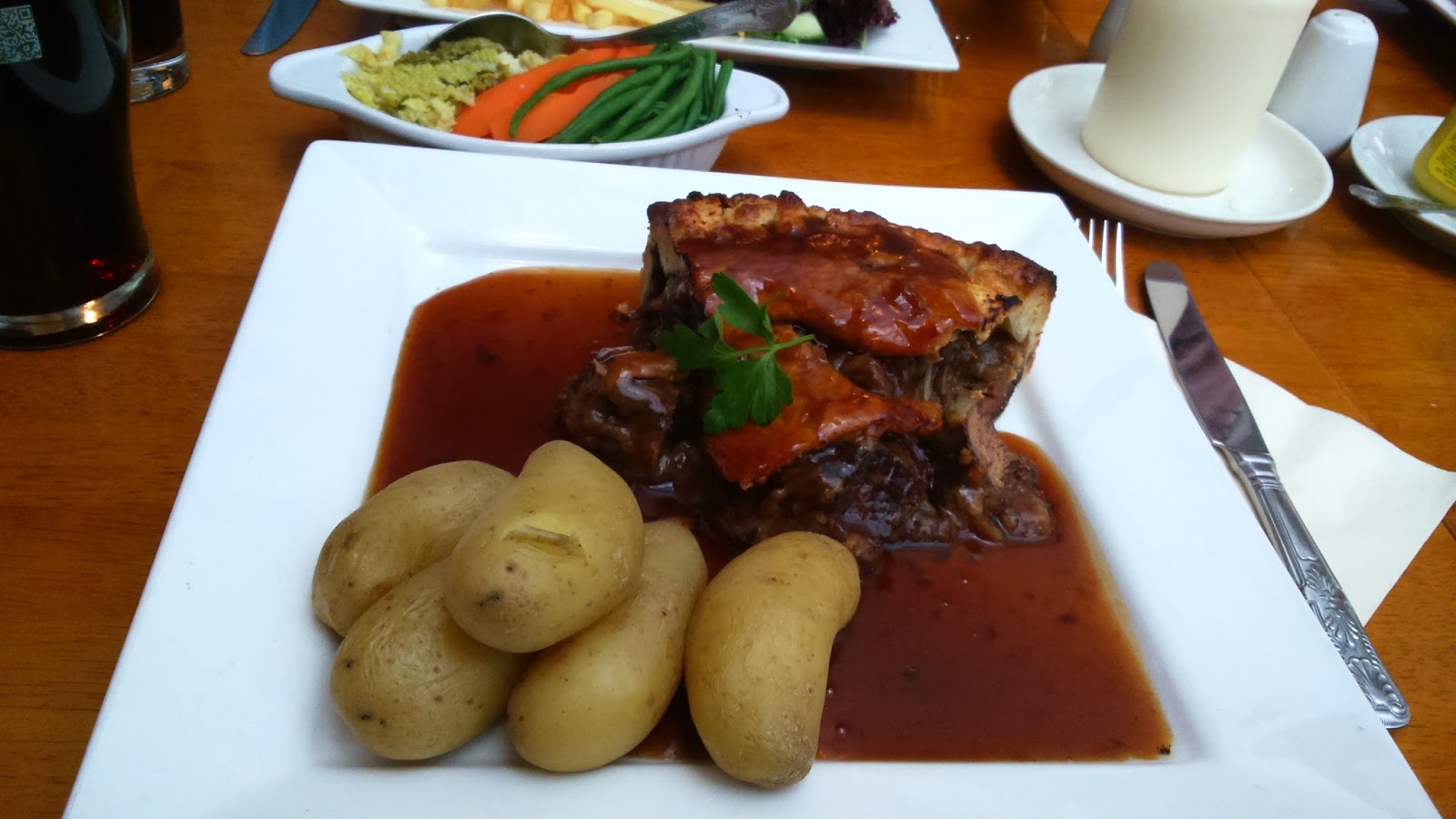
I have written about the Fountain before, and have eaten at this excellent Harvey’s pub on a number of occasions. I therefore knew my steak pie (and a proper pie at that), complete with new potatoes and vegetables was going to be just right, and it certainly was. The steak filling was cooked to perfection and just melted in my mouth; as did the excellent pastry casing. To accompany my meal there was some superb Harvey’s Old; the first, and quite possibly the last, I have sampled this season. Also on sale were Harvey’s Sussex Best and IPA.

Shortly after 4.30pm we once again boarded our coach and departed from the Fountain, heading towards our final stop of the day, the Rock at Chiddingstone Hoath. The Rock is an old favourite, and is another example of an unspoilt pub. Situated on high ground to the west of Penshurst, the pub takes it name from one of the striking rocky outcrops nearby. It is believed to date back to 1520 and was at one time an old drover’s inn. Today it remains as a fine example of a 16th century pub, boasting a wealth of original features and a large inglenook fire place.

The entrance and the main bar have a floor of well-worn brick. The bar counter is straight ahead; whilst to the left of the counter is the large fireplace, containing an equally large wood-burning stove. This was certainly chucking out plenty of heat when we arrived at around 5pm. There is also a smaller, and a cosier saloon bar leading off to the right.

Rock, Chiddingstone Hoath
The pub was reasonably full with a mixed bunch of locals and other characters, but we all managed to find our way in, and some even managed to find a seat. A group of us made a bee-line for the fire, whilst others had a go at the Rock’s other attraction, the 100 year old “Ringing the Bull” game. The choice beer-wise was Larkin’s Traditional and Pale, plus Peregrine Porter from Cotleigh Brewery in the West Country. Phil, the landlord, hails from the South-West, so the pub often features Cotleigh beers. I tried the Larkins Pale and the Cotleigh Porter, and can report that both were in fine form.

We left the Rock around 6pm, and boarded our coach for the journey home. The driver dropped the bulk of the party in Tunbridge Wells, and the rest of us, including me, in Tonbridge. A few hardy souls continued on to Wetherspoons, but I had drunk sufficient beer over the course of the day to call time on any more, so made my way home.

The trip reminded me, once again, of how lucky we are to live in such an attractive and picturesque part of the country, and of how blessed we are to still have such fantastic pubs. Do take the opportunity to visit them if you are ever in the area.