Monday, 25 August 2014

A Day in the Bavarian Alps


Street scene, Mittenwald
Just over half way through our stay in Munich we took advantage of the efficient German Rail System to journey south for the day, into the Bavarian mountains. Our destination was the small town of Mittenwald; one of the highest towns on Germany and being almost right on the border with neighbouring Austria, just about as far south as one can go and still be in the Federal Republic.

Comfortable and fast Regional trains depart from Munich’s Hauptbahnhof hourly, with a journey time of just under two hours. En route the line skirts the Starnberger See, the biggest of several to the south of Munich, before heading off in a south-westerly direction towards the town of Garmisch-Partenkirchen; home to many winter sporting events as well as the 1936 Winter Olympics.

As our train sped south, the scenery became more and more spectacular, with the mountains steadily growing in the distance as we approached them. We had other plans first though, as we wanted to pay a brief visit to the monastic brewery of Kloster Ettal. Some homework prior to our departure for Germany  revealed that Ettal is just a 10 minute bus ride way from the railway station at Oberau. What was even better was the fact our train ticket was valid on the bus which, like many services in the region, is operated by Deutsche Bahn.

Alighting at Oberau and walking the short distance to the bus stop, it appeared we weren’t the only thirsty pilgrims heading to the monastery that day. Around half a dozen others were making the same journey, although most must have stayed for longer than we did, as only one other couple shared the journey back with us.

Almost as soon as we left the station and crossed the busy north-south highway, our comfortable coach-style bus began to climb, and soon the road was snaking its way up into the mountains, with pine forests on one sideband steep ravines on the other. Before long we reached our destination, the small settlement which has grown up around the imposing abbey church of Kloster Ettal. We left the bus and crossed the road to the monastery entrance.

I had read briefly about Kloster Ettal and its monastic brews, but wasn’t quite prepared for just how close the monastery is to the mountains. Dating back to the early 1600’s, the imposing abbey church was rebuilt in Baroque style following a fire in 1744. Today, the complex functions as a Benedictine abbey with a community of 50 monks, and as well as its own brewery operates a distillery, a bookstore, an art publishing house, a hotel, and a cheese factory. The distillery produces Ettaler Kloster Liqueur, a herbal liqueur which comes in both a sweet yellow and a more herbal green varieties.

Klosterhotel Ludwig der Bayer
There was building work going on outside the church, so we skipped a visit there and instead made for the Kloster shop. There I bought some bottles of Kloster Ettal beer and a few post cards. We them retraced our footsteps back across the road to the Klosterhotel “Ludwig der Bayer”, which is owned by the abbey. As the adjacent photograph shows, the hotel is quite an imposing building and is obviously a popular stop-over place for people visiting this picturesque part of the Ammergauer Alps.  It seemed quite up-market as well, but the waitress didn’t mind us sitting in the Braustüberl just having a drink (Klosterbräu Ettal Helles). 

We then caught the 12.19 bus back to Oberau station, and after a short wait boarded the 12.45 train to Mittenwald, some two hours after our original train. The train divided at Garmisch, with only the front portion continuing on to Mittenwald. The single track line climbed steeply up through a wooded valley towards out destination, and some 20 minutes later we alighted at quite a large station over-looking the valley of the River Isar; the same river which flows through Munich.

Mittenwalder beer
Despite the sunshine, it felt decidedly chilly as we walked the short distance from the railway station into the centre of town. We called in briefly at the tourist information office, primarily to pick up a map, but seeing as it was lunchtime and that we hadn’t eaten since breakfast we decided to go in search of some food and drink. Like most towns in Bavaria, Mittenwald has its own brewery, and Mittenwalder Privatbrauerei claims, with some justification, to be the highest in Germany.    

Beer garden, Gasthof  Stern
As might be expected, the brewery has several outlets in the centre of town, and the one we chose, Gasthof Stern was very good. Despite the chill, we sat out in the partially covered beer garden at the rear of the pub, from where we had an excellent view of the imposing mountains, just across the valley. We enjoyed a glass each of the very pale-coloured Mittenwalder Helles, along with a traditional Bavarian favourite of Leberkas mit Spiegel Ei und Kartoffelsalat. (Baked, finely-ground pork and beef loaf, topped with a fried egg and accompanied by potato salad).

Leberkas mit Spiegel Ei
After that we had a look around the town which was larger than it first appeared. It is a picture-postcard sort of place, with unbelievably pretty, flower-bedecked Alpine houses and shops. Needless to say it was crowded with tourists, including some from Birmingham if the accents were anything to go by. We found a supermarket where I was able to buy a couple of bottles of Mittenwalder beer to take back with me, (my rucksack was getting rather heavy at this point!)

There is a cable car cross the valley which runs up to restaurant and viewing area, high up one of the mountains. We toyed with the idea of taking a ride up the mountain, but unfortunately the peaks were shrouded in clouds, so we would not have seen much had we gone up. Time was getting on by now anyway, and although the last train back to Munich doesn’t leave until10.30pm, we made our way back towards the station to check on the times.

Mittenwald
Close to the station was a wooden cabin café, with several groups of people sitting outside at tables, chatting over a beer or two or a glass of Schnapps. We decided to join them and enjoyed a further glass of Mittenwalder Helles, before catching the 4.30pm train back to Munich. The journey back was every bit as scenic as the outward one, and the countryside looked even more attractive now that the sun was shining.


I can certainly recommend a visit to this attractive part of southern Bavaria, especially to anyone who appreciates spectacular scenery. Beer wise there is much to offer as well, and whilst this part of Bavaria, know as Oberbayern doesn’t have the same large concentration of breweries as say Franconia in the

Tourists in Mittenwald

north, the combination of mountain scenery, picturesque old inns and decent beer is a winning one in my book. Well known beer writer Des de Moor wrote a piece about brewing in nearby Murnau, and a while back, writing in CAMRA’s Beer Magazine, he described a beer and hiking holiday in the region. Now given my enjoyment of walking in the countryside, coupled with my passion for good beer that for me would be a holiday which would come close to heaven!


I believe this is the company referred to in Des’s Beer Magazine article.

Sunday, 24 August 2014

That Magic Headache Ingredient


Thirty years or so ago during the early 1980’s, when I was living in Maidstone, a friend who was older, and much wiser than me came out with a statement that was pertinent then, and still holds true today. He was describing the morning after a night spent drinking Shepherd Neame beers, back in the day when the company’s beers were worth drinking, and when they also had a considerable presence in Kent’s county town.

“What is that magic headache ingredient in Shepherd Neame beers?” my friend asked. Of course neither of us knew the answer, but we both knew what he was talking about, as even a moderate session on Sheps invariably led to a sore head the following morning. This was in sharp contrast to the other readily available cask beer in West Kent at the time; Fremlins Bitter. You could drink a gallon of the stuff and still feel OK the next day!

I’ve pondered this question over the years, but never arrived at a satisfactory answer. One thing I have noticed though is that the next day headache is NOT related to the alcohol content of the beer. I was reminded of this fact last Friday morning, having attended a CAMRA meeting the night before. The meeting took place at a pub in Tunbridge Wells.  I had arrived late, the pub was an old one and it was quite dark in the bar. The pub was tied to Greene King, but like several others locally the licensee is allowed to stock several guest beers.

A beer called Swordfish from Wadworth caught my eye, and I have to say it was rather good. I have never been a huge fan of the company’s flagship beer, 6X. There’s nothing wrong per se with the beer, it’s just that a heavily malt-driven ale is not to my taste. If anything Swordfish was even maltier than 6X, but after eight days in Bavaria, drinking predominantly hop-driven, light-coloured beers, it slipped down rather well; so much so that I ordered another. It was only after a friend pointed out the beer was 5% that I thought it perhaps prudent to switch to something lighter for the final beer of the evening.

The next morning I had the headache from hell, and it was then that I decided my discomfort must be due to something in the beer, rather than just its strength. After all, a few days previously I had been drinking Bavarian beers of a similar strength, and in greater quantity, with nothing worse than a dry mouth the following morning. Without a doubt, this new beer from Wadworth had that infamous “magic headache ingredient” but what could it be?

Research shows that classic hangover symptoms are not due solely to excess alcohol (ethanol), although if one has obviously over-indulged, rather than just having had a few pints, then the high levels of alcohol in your system will make you feel rough regardless. Drinking an alcoholic beverage that contains impurities or preservatives can give you a hangover, even if you only have one drink.

 Some of these impurities may be other alcohols besides ethanol. Other hangover-causing chemicals are congeners, which are by-products of the fermentation process. These “higher alcohols” and congeners are more likely to be formed when fermentation takes place at higher temperatures, which would explain why the beers  I was drinking in Munich the other week did not have this effect; having been fermented and matured at a lower temperature than traditional English ale.
 

So in the interests of further research, and as something of a project to list out beers to watch out for if you don’t want too much of that “morning after feeling”, which beers, in your experience, have that avoid at all costs, “magic headache ingredient”?

Friday, 22 August 2014

Something in the Air

Straight out of the terminal
Airport bars are renowned for stocking a limited range of over-priced “international” beer brands, and are not normally the sort of places to attract the seasoned beer hunter. In the UK, the appearance of Wetherspoons at various airport terminals, has been a welcome addition in terms of choice of beers, but most of these outlets are like darkened cabins, shoe-horned into the terminal building, with little to distinguish them from other airport watering holes. The beer may be good, but drinking it is not such a pleasant experience, with all the queueing and jostling for space associated with many JDW city outlets.

Travellers passing through Munich’s Franz Josef Strauss International Airport though have the choice of stopping off for a tasty glass or two of house-brewed beer at Airbräu; a large brew-pub situated in the open concourse area, called the Munich Airport Centre, or MAC, between Terminals One and Two. Opened in 2008, Airbräu has been a favourite stop off of mine when either arriving, or departing from Munich. What I particularly like is the large outdoor beer garden which takes up part of the concourse. As the concourse is covered by a large flexi-glass roof, one can still enjoy a beer during rainy weather.
The tasty, house-brewed Helles

Airbräu offers three standard brews, plus seasonal beers which change throughout the year. All the beers are unfiltered and very tasty to boot, and what’s more they are cheap. On our recent visit we paid €2.75 for a half litre of Fliegerquell (their standard unfiltered Helles), and €2.45 for their Jetstream Pilsner.

The combination of good beers and keen prices ensures a steady stream of customers, but unlike the JDW outlets at UK airports, where the service is frenetic and the place rammed, sitting out in the beer garden at Airbräu is a much more relaxed and pleasant experience. Although I haven’t eaten there, the food offerings at Airbräu look good and, judging by the number of people dining last Monday, they appear very popular as well.
Enjoying a beer before the flight

A visit to Airbräu is a good start to a holiday or any other trip to Munich, as well as a good place to end a break on. We have made a point of calling in there now on our last three trips to the Bavarian capital, and if you are heading that way, and have sufficient time to do so, then I strongly recommend you do the same.

Thursday, 21 August 2014

Who Would be a Wirt?

As mentioned in the previous post, we experienced a few days of inclement weather in Munich. After sitting in the Bräustüberl, or restaurant section of a couple of beer gardens, and watching the rain pouring down outside, I was left pondering what happens to the myriad of staff who would normally be employed serving and generally looking after the running of the beer garden?

This is not such a dumb question as it might at first seem, as even the self-service areas (Selbstbedienung) require staff to man the serving hatches (both the food and the drink ones), people to man the tills at the exits, and staff to go round collecting up the empty glasses and plates. In addition, extra waiting staff are needed to look after those areas which are not self-service.

So, what happens when it rains? What do the management do with all these extra people? Are they sent home without pay? Or are they employed on a casual basis anyway, where they only get paid for those days/sessions they actually work? Also, how does the management cater for the decreased demand? Beer is probably not too much of a problem, but perishable items, such as meat and vegetables almost certainly are, and when the demand is not there, what happens to all those knuckles of pork and roast chickens?

Then there is also the financial aspect of decreased turnover. Again, most establishments will be able to cope with the odd rainy day or two, but what if the wet spell is prolonged? This must be of particular concern to the larger beer gardens; places such as Hirschgarten or Chinesischer Turm which, at their peak, can cater for upwards of 8,000 drinkers? Knowing the Germans and their legendary reputation for efficiency, I expect they are more than able to cope with these sorts of situations, but as an outside observer who is involved in allocation of work duties on a day to day basis, I was just wondering how it all works out.

Wednesday, 20 August 2014

Not Exactly Beer Garden Weather!


Under cover at Tegernsee

I was beginning to think that weather-wise, our trip to Munich was cursed from the start. Just prior to the weekend we flew out, a weather presenter announced that the “Jet Stream” had suddenly moved south, which meant the summer weather would be coming to an end. On top of that the remains of tropical storm “Bertha” would be due to hit the UK on the day we were due to fly out to Germany.

A brief respite from the rain.
Sure enough we drove up to Stansted through some torrential downpours, but on landing in Munich and walking off the plane into 28 degrees of heat our spirits rose and thoughts of depressions and “Atlantic Lows” quickly vanished. Cue the following morning though and we were greeted by leaden-grey skies and persistent rain. I seriously thought the “Curse of Tandleman” had caught up with us, and we were in for a wet week! (For an explanation, click here.).

As things turned out we had a “mixed bag” weather-wise, although by mid week the temperatures in the balmy high twenties had disappeared, and the mercury was hovering around the mid teens. Not the beer garden weather we had been anticipating, but we still managed to make the most of our time in the Bavarian capital, visiting some fine establishments, enjoying some excellent local beers; combined with a couple of trips out into scenic countryside around Munich and further a field.

Umbrellas were definitely the order of the day.
Things seemed pretty rosy on the beer front, and from a beer hunting point of view there have been several positive developments with the welcome appearance of beers from out of town providing some much needed relief from the monopoly of Munich’s “Big Six” mega-brewers. There is also a small, but growing “craft beer” movement within the city, and I was able to pick up a couple of bottles from one of these – Giesinger Bräu.

For the benefit of the curious, there will be several posts on our visit to follow, in due course.

Saturday, 9 August 2014

Return to Munich

A welcoming Maß
The boy and I are off to München tomorrow. This will be my fifth visit to the Bavarian capital in the last nine years and I have to say I’m really looking forward to it. We’ve a rather full itinerary of places to visit that I’ve mapped out, including a few old favourites, such as Kloster Andechs, Liebhards (Aying), Tegernsee and Forschungsbrauerei, but I’ve also included somewhere a bit further a field; namely Mittenwald – right on the border with Austria, and home to the highest brewery in Germany. En route we’ll hopefully get the chance to stop off for a few lunchtime bevies at Kloster Ettal as well.

Beer from the wood
I’m hoping that it will be beer garden weather for the duration of our eight day visit, as there’s nothing better than sitting out under the shade of the chestnut trees, enjoying a Maß or two, However, the 10 day forecast for Munich is looking very changeable at the moment, with cool temperatures for the time of year and quite a lot of rain. Never mind; we’ll just have to revert to indoor drinking instead!


Tandleman wrote recently about Bavarian beer gardens; specifically Augustiner Keller, and if the weather’s good when we arrive Sunday on evening I expect we’ll be calling in there. If it isn’t, then it's Weisses Bräuhaus for dinner, followed by a Maß at the Hofbräuhaus; and that is the beauty of Munich – so many places to choose from that, come rain or shine, we’ll find somewhere to slake our thirst and satisfy our bellies.
Kugler Alm - right out in the sticks

As on previous trips I’ll be including my now rather battered copy of “The Beer Drinker’s Guide to Munich”, written by American Larry Hawthorne, and although it is now in its 6th edition, in probable need of updating. Nevertheless the book is still an indispensable guide to tracking down the best beer gardens Munich has to offer, especially when one considers that many of them are quite tucked away and are largely only known to locals.

On our last two trips we visited some excellent establishments, including Menerterschwaige, Waldwirtschaft Groβhesselohe (Wa-Wi), Hinterbrühl, Hirschgarten, Alter Wirt, Insel Mühle and Kugler Alm to name but a few. Hirschgarten is reputed to be Europe’s largest beer garden, and serves Edelstoff from a wooden cask. We’ve been there a few times and it’s unbelievably busy, and seems especially popular with younger people. There are also several well-known beer gardens in the Englischer Garten (Munich's equivalent of Hyde Park), including Seehaus, Osterwald and the famous Chinesischer Turm.
Chinesischer Turm - Englischer Garten

Gardens such as Insel Mühle, Menerterschwaige, Kugler Alm and Hinterbrühl are all a bit more tucked away, but part of the fun is tracking them down and getting there; a task made easy with the help of Larry’s book and Munich’s excellent, fully integrated public transport system.The system offers various options, depending on the number of people travelling, zones one wishes to visit and also includes a three day option. All tickets allow easy switching between rail (both suburban rail as well as underground lines), buses and trams, and makes getting around the city a breeze.

Hinterbrühl
I have written before about Bavarian beer gardens, so I won’t repeat previously published information here, apart from saying the beer gardens are great social levellers, attracting people from all ages and from all walks of life. Some allow patrons to bring their own food along, as long as they buy beer from the garden, of course. Most offer inexpensive and hearty food, as well as the choice of self-service or waiter/waitress service.

They are popular with people on their way home from work, and at weekends they are equally popular with families, keen to escape the confines of hot apartments and escape into the fresh open air of the beer garden. There are around 180 such places in the city, ranging from small local gardens, serving a particular area, right up to the aforementioned Hirschgarten, which can accommodate up to 8,000 people!
Empty wooden casks at Hirschgarten

Here’s hoping we spend at least some time drinking outdoors in a few of these excellent establishments; but we are also looking to track down some Bavarian craft beers, as well as enjoy a few beers brewed out in the more rural regions of Bavaria.

For those interested in learning more about Munich's Beer Gardens, click here and the link will take you to an interactive site which lists most of them in the city, and the surrounding area.

Kloster Andechs
I had also intended putting up a link to the Beer Drinker's Guide to Munich website, but my virus checker blocked the link, as it appears the site has an infection. If you are reading this Larry, you need to check your site urgently, as it's been attacked!


Friday, 8 August 2014

A Night with Franciscan Well Brewery – EBBC14


I promise this will be my last post about the 2014 European Beer Bloggers Conference, as I’m certain that the majority of readers, who weren’t at the event, are probably sick and tired of my continual going on about it by now.


On the last evening of the conference, attendees were treated to a 4-course beer dinner hosted by Franciscan Well Brewery, of Cork. Founded in 1998, in the heart of Cork’s historic quarter, on the site of a 13th century Franciscan monastery, Franciscan Well is famous for its naturally-made range of Irish and European-style beers. Franciscan Well is now owned by Molson Coors, who were a major supporter of the 2014 European Beer Bloggers Conference.

I also have to declare a personnel interest in the company, as I have a pension with Molson Coors. This came about following the latter’s acquisition of the brewing division of Bass, in the wake of the fall-out from the Beer Orders 1989. I began my laboratory/quality control career working for Bass, at their wines & spirits subsidiary, Hedges & Butler, in London’s East End, back in the late 1970’s, and now I have a small pension maturing somewhere in Molson Coor’s coffers, waiting for me when I retire.

This special beer dinner took place at the EBBC conference venue, The Church, and the kitchen staff there certainly pulled out all the stops to prepare some truly exquisite food. Franciscan Well founder and brewer, Shane Long, hosted the evening, sharing his thoughts on the advancement of the Irish Craft Beer market. Unfortunately I can’t remember much of Shane’s talk, as not only had I stopped taking notes at this stage, but I’d been drinking pretty solidly since lunchtime, and things were slowly sinking into an alcoholic haze! However, Shane is on record as saying:

“It’s Fantastic that the conference is being held in Ireland, a testament to how far we have come in the craft beer world. We look forward to hosting the writers.”

The evening kicked off with a welcoming glass of Rebel Red – Irish Red Ale. I have to confess I’ve never been a fan of Red Ales, but the style is native to Ireland and Franciscan Well’s version was pretty good, and helped to get the digestive juices flowing as we moved onto the starter. 

This consisted of Deep-fried calamari dusted in wasabi and sesame flour, served with a seasonal leaf salad, sweet chilli and aioli dips. The starter was paired with Friar Weisse; Franciscan Well’s Bavarian-style Weiss beer. The food and the drink certainly complemented each other, so full marks there!

Main Course
Moving on to the main course of dry-aged Hereford beef burger topped with Cashel blue cheese, beef tomato, gherkin, baby gem lettuce on a lightly toasted brioche bap with hand-cut chips, we had some rather good Franciscan Well Chieftain IPA to wash the complement the food and help wash it down.

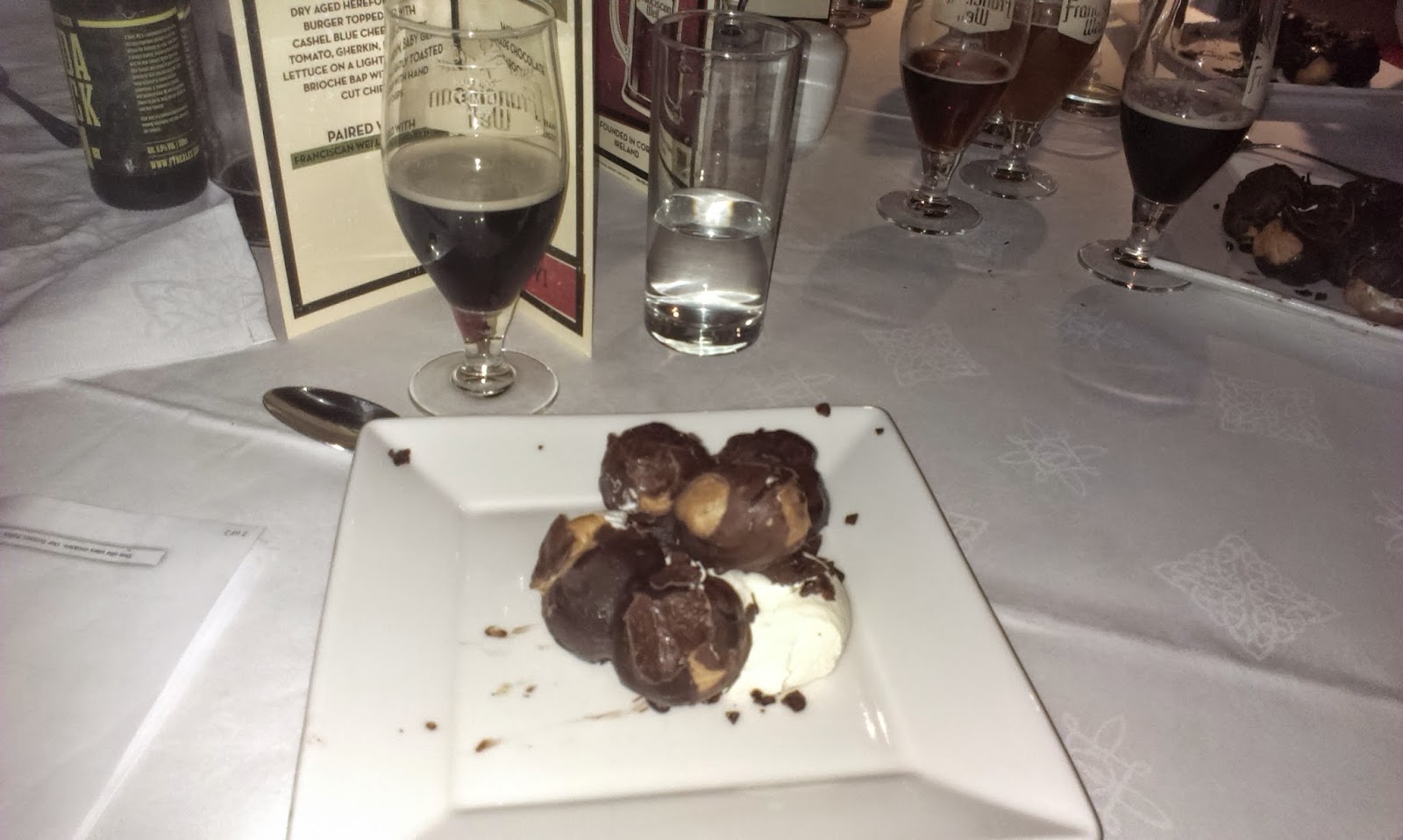
Dessert, consisting of crouchenbouche-profiterole tower drizzled with toffee and chocolate, followed. A difficult mix of sweet, chocolaty tastes to find a suitable beer to go with this one, but Franciscan Well’s choice of their Shandon Stout fitted the bill surprisingly well.

An indulgent dessert
After all this rich and some might say pretentious-sounding food, was there room for anything else? Well, as a digestif the company came up with a version of the above stout, which had been aged in Jameson Irish Whiskey casks. A few homemade macaroons were placed in front of us, just in case we weren’t already bursting at the seams, but all in all it was an excellent, if rather indulgent, meal. Our thanks to Shane Long and his colleagues at Franciscan Well, plus the kitchen staff at The Church who certainly pulled out all the stops to create this culinary feast for us, and to make it such an enjoyable evening.

Thursday, 31 July 2014

EBBC 2014 - The sessions


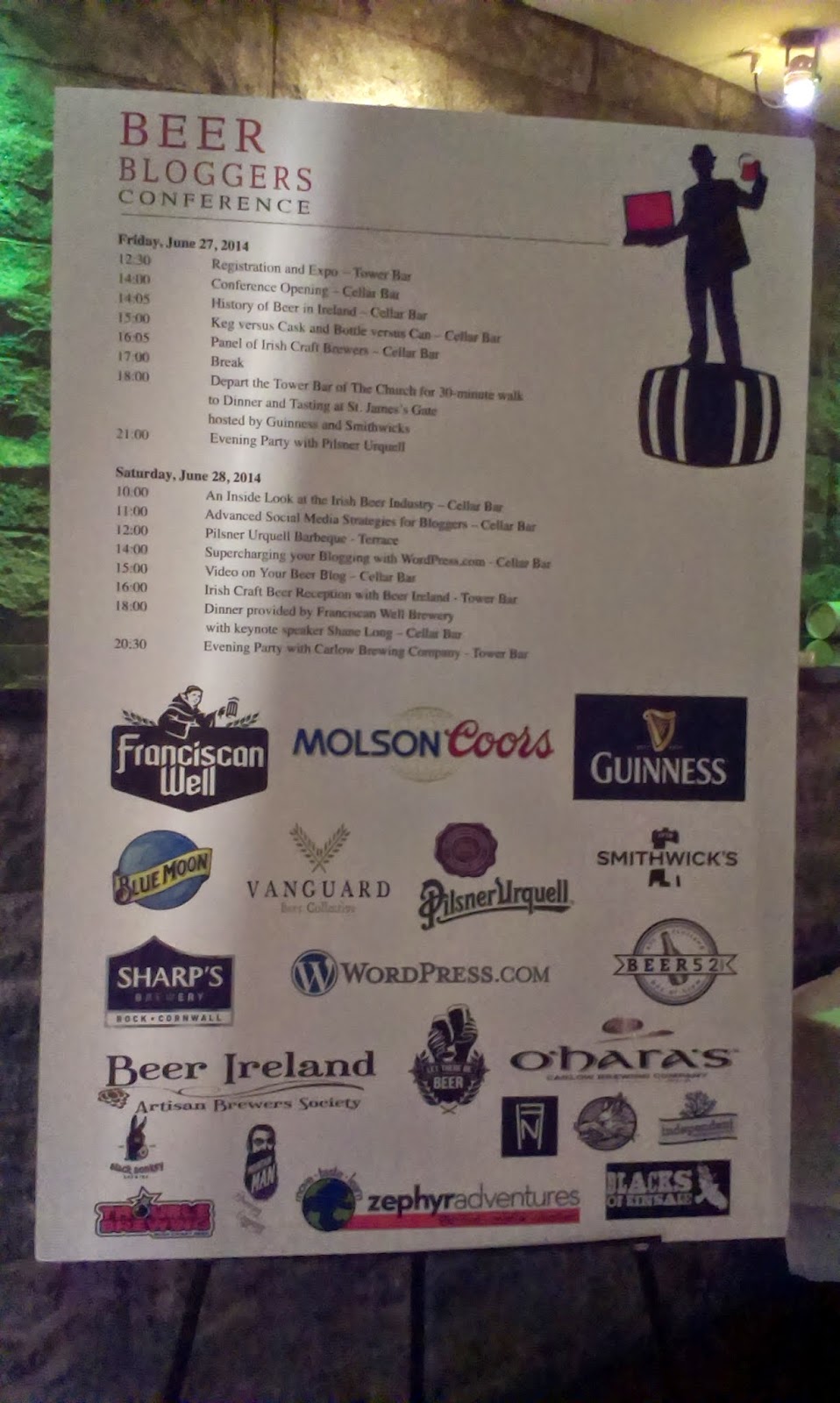
Conference Agenda

So a month on and what was the EBBC all about? That’s probably a difficult question to answer in a few lines, as the truth is the conference was a myriad of many different things. Leaving the important business side of the event to one side for a moment, probably the biggest single thing to come out of the weekend was the discovery (for me at least, and I’m certain many others as well) of the strength of the emerging Irish Craft Beer Movement.

Whether this was by accident or design, or a combination of both, the overwhelming message that came across was that good, and quite often great, beer is alive and kicking in the island of Ireland. We were treated to four separate samplings of Irish Beer; five if you include Friday evening’s visit to the Guinness Brewery at St James’ Gate. Basically we encompassed the entire spectrum of beer in Ireland, from the huge multi-national that dominates the domestic beer market, right down to breweries which were just starting up. One doesn’t even yet have a permanent home, but is turning out some superb beers by “cuckoo brewing” using other people’s brewing plant.

The state of the Irish Craft Beer market is worthy of a post of its own, and hopefully I’ll get round to writing about it whilst it’s still relatively fresh in my head, but for now I’d like to return to describing what the business side of the conference was all about.

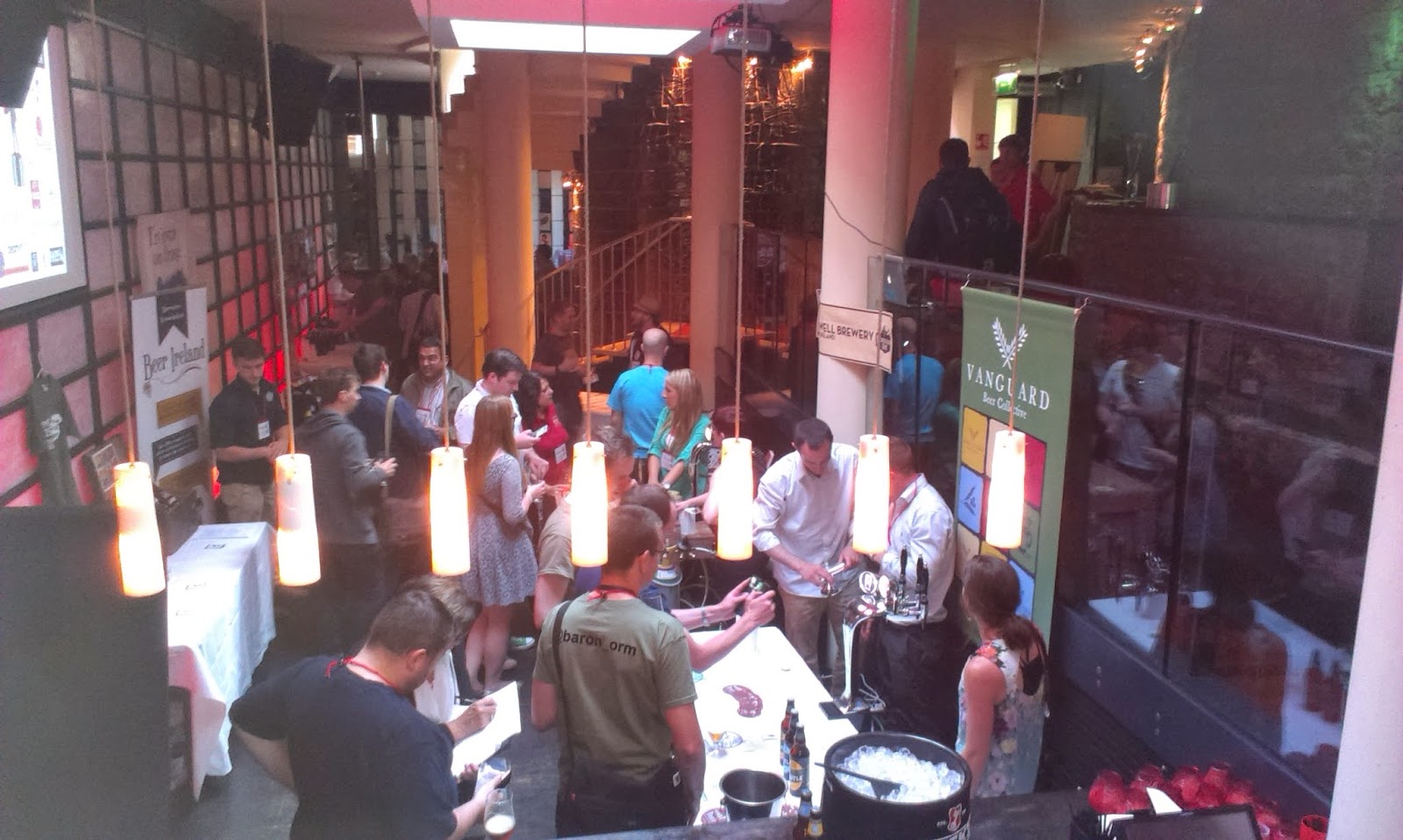
A number of different and quite varied topics were discussed, and there were several presentations. Some I found a lot more interesting than others, but one thing they all had in common, and the once common thread running through all of them, was that of beer. Following registration on Friday lunchtime, the conference kicked off with an introduction to Irish Craft Beer, before moving into the adjacent room set aside for the conference proceedings.

Vanguard Beer Collective
Historian, Declan Moore kicked off with his presentation entitled The History of Beer in Ireland. I must confess that despite spending time with Declan later that evening, and finding him positively charming, I found the whole subject of  Stone Age Brewing somewhat of a turn-off. So much so that, quite shamefully, I nodded off! There was just too much speculation and conjecture for my liking, and anyway the whole thing was so far removed from brewing as we know it, as to be of virtually no interest to me. (Sorry, Declan!)


Declan’s presentation was followed by the inter-linked topics of Keg versus Cask and Bottle versus Can. James Winans of the Vanguard Beer Collective and Brian Short from the Brown Paper Bag Project presented the pros and cons of these four packaging methods. I have already covered the Bottle versus Can debate, and whilst some interesting points were raised in the other half of the debate, I don’t intend to cover them here, as they are worthy of a separate post.

I said that there was a common “Beer Theme” running through the various topics, but that wasn’t quite true, as the two presentations on Saturday afternoon were about “How to Enhance Your Blog”, and “Supercharging Your Blogging With WordPress.com”. Both presentations were of much interest to me, and from a practical point of view, were by far the most useful of all the topics covered.

Cindy Molchany, from conference organisers, Zephyr Adventures, kicked off the first presentation with some really useful tips and advice about how to get one’s blog across to a wider audience. She also emphasised the importance of a strategy and covered how to add to its appeal, thereby attracting more interest, and more followers. I won’t go into detail here, but suffice to say I came away with lots of useful ideas and suggestions of how to improve both my blog and my online presence. So thanks, Cindy.

We were then treated to a real cool Californian dude representing Auttomatic – the company behind WordPress.com. My own blog is hosted by BloggerGoogle’s own free blogging software. Now I know quite a few Bloggers who have switched from Blogger to WordPress, so I was keen to discover the pros and cons of both systems.

Derek  Springer (with the hat) from WordPress.com
Derek Springer, an accomplished home brewer, beer expert and programmer from Auttomatic, was very much in his element, and gave an excellent talk about how WordPress operates, explaining how the software has become the programme of choice for many Bloggers. He explored in some depth the ways in which bloggers can maximise the impact and reach of their posts, and like Cindy earlier, presented us with lots of useful tips and ideas.

Probably the most bizarre session was the first one on the Saturday morning. Billed as “The State of the Brewing Industry in Ireland”, Dean McGuinness, Managing Director of Premier International Beers, kicked off the day’s session with an insider’s look into the Irish Craft Beer Industry.  Dean used examples from abroad, (primarily the UK, but also, Germany – strangely enough), to illustrate his talk and demonstrate how “craft brewing” had taken off overseas, and was now beginning to establish a foothold in Ireland.
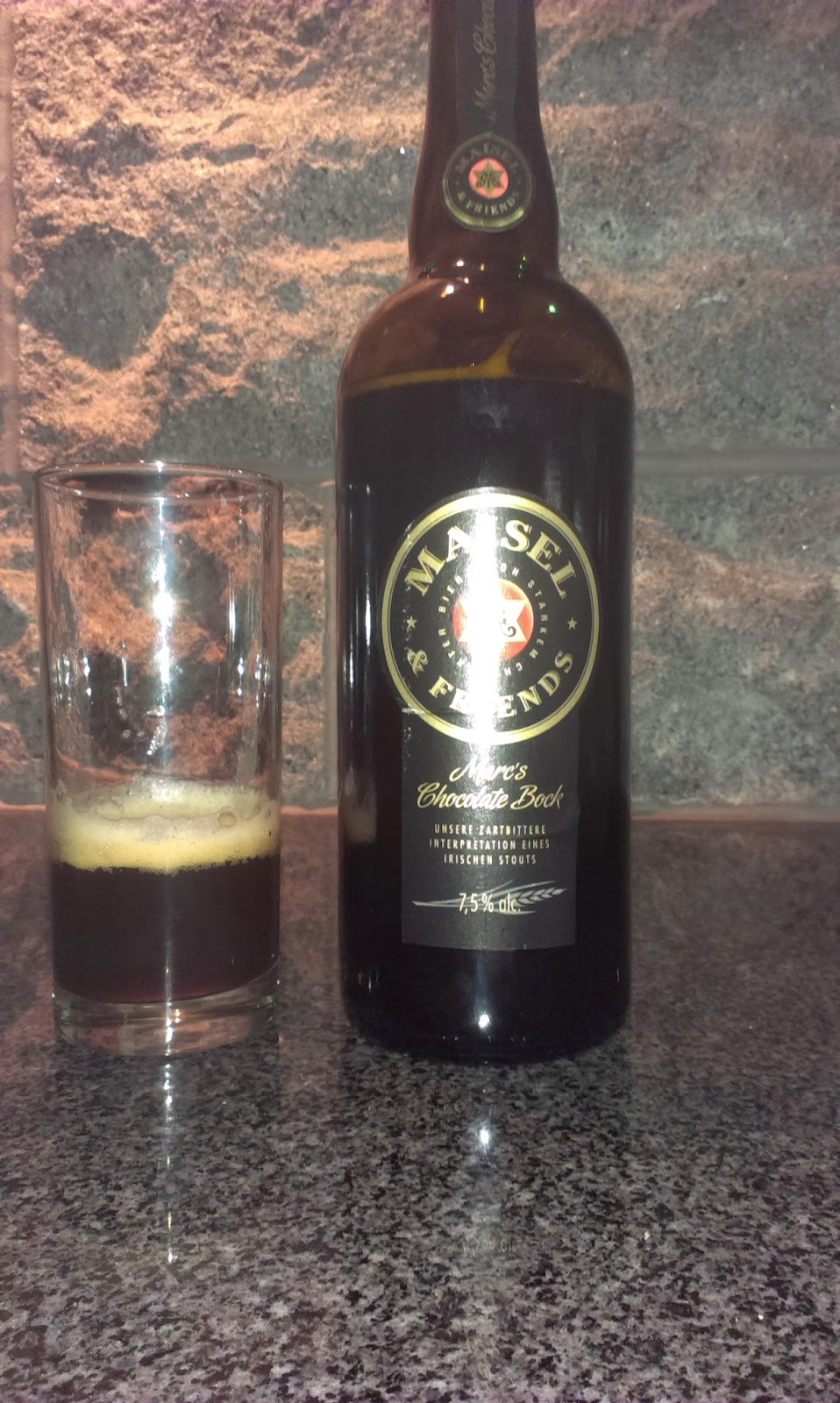
Chocolate Bock from Maisels

Using the examples of  Thwaites, Crafty Dan, and Black Sheep from Britain, plus Maisel & Friends from Bayreuth, Bavaria, samples of beers from these breweries were passed around to further make the point. If I told you this took place shortly after 10am when I was still recovering from the excesses of the night before, you will understand why I gave all these interesting beers a miss. The fact that that they were all strong beers, with the Black Sheep Progress weighing in at 10.0%, and the Maisels at 7.5%, you’ll understand my reluctance to start imbibing even more!

In some ways this was a pity, as the Black Sheep Progress was a limited edition beer brewed to celebrate 20 years of brewing, whilst the Maisels was a Chocolate Bock, (not sure if that’s strictly Reinheitsgebot?). Maisels have also revived some classic German lager styles, under the Aktion banner. I did, however, get to taste the Chocolate Bock later in the day.

The final presentation of the afternoon was all about "Video on Your Beer Blog". We heard from two experts on how to incorporate videos into your blog and how to promote those videos better.  Tomasz Kopyra is a Polish beer blogger who has successfully incorporated video into his blog and has 29,000 YouTube subscribers, whilst Mhairi MacLeod is director at Lux, Scotland’s only creative agency dedicated to food and drink, who carved her career from beer blogging. This was all new to me, but was a subject which left me with a lot of food for thought.

There in a nutshell, is a very brief synopsis of what exactly went on at the conference. Leaving aside the socialising, the beer sampling and brewery visit for one moment, these presentation were invaluable lessons and insight for anyone who wishes to improve, enhance and ultimately expand his or her blog. These sessions alone made the EBBC 2014 well worth attending.

Saturday, 26 July 2014

A Drop of the Black Stuff

Few brands are more iconic and well-known in the world.

The first day's proceedings at the recent European Beer Bloggers' Conference in Dublin ended with a tour around the world famous Guinness Brewery at St James’s Gate. The tour was followed by a beer and food pairing, which was one of the highlights of the trip. Before I go any further, I have to say the Guinness Brewery was not at all like I expected. I had been told beforehand that the site occupied some 64 acres, but it wasn’t until we approached the maze of streets which led to the brewery that I realised just how old parts of it are.

We arrived on foot; having been escorted in a number of groups by guides from the Dublin Tourist Authority. Our guide was quite a character, and on the 20 minutes’ walk over from the conference centre, he pointed out places of interest, including many historic sites. These included Dublin’s two cathedrals, and ranged from the famous Halfpenny Bridge over the River Liffey to the church where Handel’s Messiah was performed for the first time . He also told us some facts about Arthur Guinness. We already knew that the founder of the brewing dynasty had been married in The Church which is now the conference centre where the EBBC took place. But much more was to follow, including the fact that Guinness was the largest employer in Dublin, and at one time it was reckoned a third of the adult population of the city was working for the company, in one capacity or another.

Cobbled streets and an old rail-track, leading to St James's Gate
As we neared our destination, we entered a series of quite narrow cobbled streets, running between stone-built 19th Century buildings. I was glad we had a guide with us, as it would have been quite easy to lose ones bearings. There were several, iconic black-painted gates, emblazoned with the legend St James’s Gate, but after several twists and turns we reached our destination; the Guinness Storehouse.

The latter is the company’s impressive visitor centre. Converted from a former fermentation block, this multi-floored Victorian building is now one of Dublin’s premier visitor attractions. It was still busy with throngs of visitors, despite it being early evening. I suppose virtually all visitors to the Irish capital want both a souvenir, plus a taste of its most famous product; even those people who wouldn’t normally drink Guinness! I didn’t bother going in the extensively stocked shop, although being open plan I could see it was stocked with every conceivable piece of Guinness merchandise imaginable.

19th Century tunnel under the brewery


Once the various parties were all assembled, we were told we would be getting a sneak preview of Guinness’s brand spanking new brew-house; which is still not fully commissioned. So after donning hi-visibility jackets and safety goggles (talk about OTT!) we were led across to the new,  No. 4 Brew-House. On the way we passed through a 19th Century underground tunnel, constructed to give workers safe passage from one part of the site to the other, avoiding both roads and the narrow-gauge railway which once criss-crossed the site. We also passed the No.3 Brew-House, constructed in the 1980's, which is still in operation, but due to be de-commissioned once the new plant comes fully on-stream.

The entrance to the shining new No.4 Brew-House
Once in the new brew-house we ascended to the top floor of the building where we were met by Fergal Murray, Master Brewer at Guinness, along with several members of his team. As the brew-house is still being commissioned, and the fact that we were the first outside visitors to be shown the plant, we were asked not to take photos. This didn’t bother me, as apart from the tops of a series of stainless steel vessels, which could have been coppers or lauter tuns, there was precious little to see anyway. I have to say new, hi-tech breweries don’t do much for me; in fact they’re a huge turn-off. Give me a working Victorian brewery any day, complete with levers and pulleys, plus various wheels to turn, rather than a soul-less steel-framed shed, and I’m much more interested.

Fergus and his team bombarded us with various facts and figures, but as I wasn’t taking notes most of them went completely over my head. What I do know is the new brew-house is extremely versatile and is capable of brewing both ales and lagers. When it comes fully on stream, not only will the adjacent No. 3 Brew-House close, but so will a number of parent company, Diageo’s other smaller, Irish breweries, including those at Dundalk, Kilkenny and Waterford, with hundreds of job losses. As well as stouts and Harp lager, St James's Gate will now brew both Bud and Carlsberg under licence, plus the Smithwicks ale brands.

There are a few crumbs of comfort in relation to the new brew-house, and these are that Diageo’s original plan was to build a new mega-brewery, elsewhere in Ireland, on a green-field site, and then sell the historic St James’s Gate site off for redevelopment. Fortunately, for Dubliners, the financial crisis of 2008-2009 intervened, forcing the company to change its plans. The construction and opening of the new brew-house confirms Diageo’s affirmation to continue brewing in the heart of the Irish capital for many years to come.

Walking back to the Guinness Storehouse
After our brief tour we retraced our steps to the Guinness Storehouse. As mentioned earlier, this visitor centre has been converted from a former fermenting block, but what I hadn’t realised was that the Perspex construction, which takes up the central core area of the building is actually in the shape of a gigantic pint glass. We were ushered into a lift which took us to the top of the building – all very “Charlie and the Chocolate Factory”. Here, several floors up, is one of the best views over Dublin to be had anywhere in the city.

I believe they call the area we were shown into the atrium, and it was here that we were to be suitably fed and watered. The Guinness management had pulled out all the stops to lay on a “beer and food pairing” for us. Starting with oysters and bottled Extra Stout, we moved on to fish and chips with Smithwick’s Bitter, followed by some superb steak burgers with Guinness Foreign Extra Stout. Finally there was chocolate mouse with Special Export Stout, brewed especially for the Belgian market.

All the pairings worked well, although I skipped on the oysters; raw shell fish have never struck me as a particularly good idea, and I didn’t want to risk a dodgy stomach spoiling the rest of my stay in Dublin!  After the food, Fergal gave a presentation, followed by a short question and answer session. One of the topics which came up was the special Guinness concentrate, or “essence”. This is sent overseas to be added to locally brewed Guinness, especially out in Africa, where the “base” beer is often brewed from more locally available materials, such as sorghum. The concentrate imparts the true Guinness “flavour” to the locally brewed stout.

Shortly after, we said farewell to our generous hosts at Guinness, and were whisked off in a fleet of coaches to begin the Pilsner Urquell party, I posted about earlier, where there was yet more food and yet more beer!

Friday, 25 July 2014

Can the Can


One of the most interesting presentations and discussions that took place at the European Beer Bloggers Conference in Dublin last month concerned the humble beer can. The discussion was led by James Winans of the Vanguard Beer Collective; a “one stop shop” organisation for the promotion, and supply of Irish Craft Beers. The presentation kicked off with a bit of history to set the scene, then examined the relative advantages of cans over glass. I have added some of my own thoughts and views on the matter, and have also researched the rise of the beer can in slightly more depth.

Persuading consumers to accept beer in cans proved a long and painful process; a process which only really started to take off during the late 1930’s, in America. Although cans were in every day use for the mass distribution of foodstuffs during the late 19th century, it wasn't until 1909 that the American Can Company made its first attempt to can beer. This was unsuccessful, and the company would have to wait for the end of Prohibition in the United States before it tried again. Finally in 1933, after two years of research, the American Can Company developed a can that was capable of withstanding pressurisation and which had a special coating to prevent the beer reacting chemically with the tinplate which the can was made from.

Some rather non-PC 1930's cans from Krueger
Canned beer finally made its debut in 1935, when in partnership with the American Can Company, the Gottfried Krueger Brewing Company delivered 2,000 cans of Krueger's Finest Beer and Krueger's Cream Ale to faithful Krueger drinkers in Richmond, Virginia. It is claimed that over ninety percent of drinkers approved of the canned beer, giving Krueger the green light to continue production.

The concept of canned beer proved to be a hard sell, but Krueger's overcame its initial reservations and became the first brewer to sell canned beer in the United States. The response was overwhelming. Within three months, over 80 percent of distributors were handling Krueger's canned beer, and Krueger's was eating into the market share of the "Big Three" national brewers--Anheuser-Busch, Pabst and Schlitz. Competitors soon followed suit, and by the end of 1935, over 200 million cans had been produced and sold.

The purchase of cans, unlike bottles, did not require the consumer to pay a deposit. Cans were also easier to stack, more durable and took less time to chill. As a result, their popularity continued to grow throughout the 1930s, and then exploded during World War II, when U.S. brewers shipped millions of cans of beer to its armed forces,
overseas.

After the war, national brewing companies began to take advantage of the mass distribution that cans made possible, and were able to consolidate their power over the once-dominant local breweries, which could not control costs and operations as efficiently as their national counterparts.

Today, canned beer accounts for approximately half of the $20 billion U.S. beer industry. Not all of this comes from the big national brewers: Recently, there has been renewed interest in canning from micro brewers and high-end beer-sellers, who are realising that cans guarantee purity and taste by preventing light damage and oxidation.

Cone-top cans from Felinfoel Brewery
The first British brewery to try tinned beer was Felinfoel of Llanelli. Canned beer was introduced as a means of  boosting the local tin-plate industry, which was struggling at the time. I have seen photos of some of these early cans. They had a conical top, and were sealed with a traditional crown-cork. Whilst growing up I can remember certain items being packaged in these sorts of tins, although as neither of my parents were drinkers, I don’t ever recall seeing beer cans of this sort. From memory it was substances like furniture, or metal polish (Brasso), that were filled into these cone-shaped containers; perhaps this is why I have always associated tinned, or canned beer with having a metallic taste.

I do remember having to pierce cans with a pointed instrument, specially designed for the purpose, and it was necessary to make two holes; one to let the contents out and the other to let air in. I am talking about soft-rinks here, but beer was also marketed in these sorts of cans, which by now had lost their conical top, and looked just like any other ordinary can.

Aluminium cans first became available in the United States, during the late 1950’s. Their lighter weight, and greater durability meant they rapidly replaced the older, heavier, tin-plate cans. Then in 1959, Ermal Fraze devised a can-opening method that would come to dominate the canned beverage market. His invention was the "ring-pull-tab". This eliminated the need for a separate opener tool by attaching an aluminium pull-ring lever, with a rivet to a pre-scored wedge-shaped tab section of the can top. The ring was riveted to the centre of the top, which created an elongated opening large enough that one hole simultaneously served to let the beverage flow out while air flowed in.

The first “ring-pull” cans I was aware of, featured in an advertisement of  Long Life beer; Ind Coope’s premium pale ale brand. The ad made great play of the ring-pull, and of the fact the beer was designed and packaged for home-drinking, and the voice-over said, “Home is where you drink your Long Life; the beer brewed specially for the home, in ring-pull cans.” Unfortunately, the only clip I could find of this advert on You Tube was of such poor quality, that it wasn’t worth including a link to it.

By the 1970s, ring-pull cans were widely available, but they came with a significant problem, as people would frequently discard the ring-pulls on the ground as litter, or drop them into the can and risk choking on them. Towards the end of the decade, Daniel Cudzik's invention of the non-removing "Sta-Tab" solved the problem. The ring-pull was replaced with a stiff aluminium lever, and the removable pull-tab was replaced with a pre-scored round tab with a riveted lever which pushed the tab open and into the interior of the can.

Today, most people, particularly in the UK, associate canned beer with cheap, tasteless lager, or equally cheap and tasteless bitter. However, in other countries cans have a much better image, and have become very popular in the United States I have written before on this subject; something which was prompted by my visit to Japan last year. There cans are extremely popular, especially on environmental grounds. But cans score highly in other ways too, being light and therefore easier to transport. They chill down quicker than glass well, and are ideal for taking on picnics, due to less weight. Finally, cans are often permitted at events where glass bottles are not.

Cans therefore win on cost, convenience, ecology and taste.  Although canning costs a lot to set up initially, once the plant is up and running the ecological advantages of the can really start to creep in. Advocates of the can, and brewers who are choosing cans, say there are clear advantages over bottles: The beer in a can cools quicker. The can protects from beer-degrading light. Beer cans are portable and take up less space, advantages both for retailers and for consumers who want to take them camping, hiking or fishing, or to sports or other outdoor events.. There is also more space on a can for wraparound design and decoration.

Retro-style Pilsner Urquell cans
Some quite large brewers are pushing ahead with promoting cans as the ideal way to store and transport beer, and this was brought home to us in Dublin at the Summer Barbecue on the Saturday lunchtime, hosted by Pilsner Urquell. There, in the courtyard, was a huge stack of cans, on display,  ready for us to take away and try. What’s more the cans were decorated with some old designs taken from the brewery’s archives, giving them a real retro look. I brought my cans home with me, but then, rather foolishly, drank them all without carrying out a taste comparison with the bottled version of Pilsner Urquell. 

A choice of container from Crafty Dan
However, all is not lost as those good folk at Beer52 have come up trumps by including both a bottle plus a canned version of Crafty Dan 13 Guns; Daniel Thwaites’ recently launched American IPA in the case of beer they sent me recently. I tried both versions side by side, and have to admit I found it difficult, to tell the difference; certainly so far as taste is concerned, although I did prefer the mouth-feel of the bottled beer, which was tighter, if that makes sense. The canned version seemed looser, and what I think this conveys is that the dissolved gas within the beer was present as much finer bubbles in the bottles than in the cans.

So much for my rather inconclusive verdict, but from what I read and hear I would say that the jury’s definitely still out on this one. What do other people think?