Saturday, 2 February 2013

The High Weald


I’ve said it umpteen times before, but we really do have some cracking pubs in this part of Kent. This is especially true of the district to the immediate north-west of Tunbridge Wells, where there is an area of high ground overlooking the valleys of the River Medway and its tributary, the River Eden, known as the High Weald. This quite isolated country of sandstone hills and ridges, crowned with substantial areas of woodland, does not really give itself to arable farming, so sheep and cattle graze in the pastures, whilst woodland activities such as coppicing and charcoal burning are carried out in the forests. The roads too are dictated by the topography and there are lots of small, isolated settlements, old farmsteads and, of course, some wonderful old pubs.

 Last weekend I was privileged to visit a few of these, mainly as part of surveying for next year’s Good Beer Guide, but also as the final act in relinquishing my Brewery Liaison Officer duties. With regard to the latter, for a period of ten years or more, I  acted as CAMRA’s BLO for Larkins Brewery, until I decided to stand down in November 2011. I agreed to continue covering this role, in a temporary capacity, until a replacement could be found, little thinking this would take quite so long. Finally, following the exit of Moodleys of Penshurst from the brewing scene, Simon, their former BLO, became available and agreed to step into my shoes and take on this role for Larkins. Although Simon lives close to the brewery, he works farther afield, so as we needed to formally introduce him to Larkins owner, and brewer, Bob Dockerty, we arranged to meet up in Bob’s local, and the nearest pub to the brewery, the Castle Inn at Chiddingstone.

Therefore on Saturday, Simon picked me up in Tonbridge, along with fellow friend and CAMRA member Jon, and we drove over to Chiddingstone for our meeting with Bob. Chiddingstone is an ancient village, well off the beaten track. Opposite the church there is a well preserved row of old houses, which are owned by the National Trust. One of these buildings houses the village shop and post office, but on its own, at the end of the row and outside the gates to Chiddingstone Castle (not really a castle, but the former manor house, re-built to resemble a medieval castle), stands the village’s crowning glory, the 15th Century Castle Inn. 

This attractive old, part tile-hung building is also owned by the National Trust, but is leased out to an approved tenant. Stepping inside the pub, especially into the right-hand public bar, really is like stepping back in time to a simpler age. With its quarry-tiled floor, low-beamed ceiling and log burning stove, the bar is the haunt of proper country types, who visit in their working clothes, often accompanied by their (working) dogs. It is a place where the world gets put to right and where the cares of everyday life can be forgotten for a while over a well-kept pint of Larkins beer, brewed just a few hundred yards down the road.

Bob was already there when we arrived, and was holding court amongst a small group of regulars perched at the bar. We ordered ourselves a pint each, (Larkins naturally); I opted for the Porter, whilst my two companions decided to go with the “half and half” mix that Bob was drinking (half of Porter, mixed with half of Traditional).  We stayed for about an hour and a half, during which time I effected the introductions, Simon had a chat with the landlord in order to complete his Good Beer Guide survey whilst Jon and I enjoyed, and joined in with, the banter that was going on. There were various comings and goings in the bar, but eventually we decided it was time to move on and drive the short distance to the next pub on Simon’s list, the equally unspoilt Rock at Chiddingstone Hoath.

The latter place consists of a few scattered groups of old cottages and isolated farms, occupying the high ground mentioned earlier. The Rock Inn stands opposite one of these groups of cottages and is named after one of the nearby rocky sandstone outcrops. Parts of the pub date back to the 14th Century, but most of the building is much younger. Until quite recently the Rock was tied to Larkins Brewery, but when the lease came up for renewal, a couple of years ago, Bob decided not to go ahead with a new one as the building was in need of some quite substantial repairs. The toilets especially were in urgent need of upgrading. The pub was close for a while whilst the improvement works were carried out, but the essential character of the pub was maintained, including retention of the ancient, uneven, bare-brick floor, which ‘elf ‘n safety had wanted to concrete over! The Rock now trades as a free house, but still of course offers Larkins beers. Traditional and Porter were on sale when we called, along with a Christmas offering from Cotleigh Brewery, down in the West Country.

The pub was pleasantly busy, which is encouraging for a damp late January night, but we still managed to find a vacant tables and sat down to fill out the survey form, enjoy the excellent Porter and just generally relax. A little later the landlord joined us for a chat. He confirmed that business had been pretty good over Christmas and told us a little bit of the pubs history. The Rock was formerly a drover’s inn, used by herdsmen taking their flocks to market. He also told us some tales of ghostly goings on at the pub; some of which he had witnessed himself.

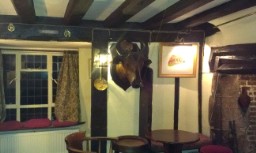
A little later we witnessed his prowess at “Ringing the Bull”, an unusual pub game involving trying to swing a metal ring, attached to the ceiling by a piece of string, onto a hook attached to the nose of a large, stuffed bulls head, mounted on the wall. This handsome looking, but rather unfortunate beast met its end in Africa, back in the 1920’s, and eventually found its way to the pub and its present purpose. The Rock is one of only a handful of pubs where this unusual game can be played, but be warned before taking on the locals, as they are well practised and highly skilled at it!

We had one more pub to inspect before the evening was out; the Plough at Leigh. This is a bit nearer to home and not really within the High Weald area. It is probably the nearest pub to Simon’s house, which might explain why he had left surveying it until last. My family and I know the Plough quite well, as we are able to cycle out to it across Tonbridge sports ground; a route which is largely off-road and therefore much safer for those on two wheels. Like the other pubs listed above, it is an ancient old inn, but one which was opened out some 30-40 odd years ago to reveal much of its internal structure.

Unlike the previous two pubs, the Plough was quite quiet when we arrived, but this was during that strange time between early and mid-evening when the last of the afternoon drinkers have departed, whilst the first of the evening’s drinkers, and diners, have yet to arrive. I didn’t take a huge amount of notice of the beer, but did spot Harvey’s Best and Westerham Grasshopper. The one which did catch my eye though was an offering from Tonbridge Brewery that I hadn’t come across before. My companions were also attracted to this one; a pale low-strength 3.6% beer which, after the much stronger Porter, made a refreshing and welcome change.

All in all, it was an excellent night out, especially as it allowed us to visit some top-rate pubs which we don’t often get out to. Special thanks then to Simon for acting as our chauffeur for the evening, but these three weren't the only pubs I visited last weekend.

The previous day I called in at another pub in the High Weald, the Kentish Horse at Markbeech, a tiny village consisting of just the pub, the church, plus a scattering of houses. Again my purpose was to carry out a 2014 GBG survey, but also to check how sales of our local “Gateway to Kent Guide" had been progressing. Somewhat embarrassingly, I noted from my records that I had last visited the pub in July2009. I remember the occasion well, as it was a scorching hot day and I had walked up through the woods and then across the fields from Cowden station. After enjoying a pint of both the Kentish Horse’s well-kept Larkins and Harvey’s, I had left six guides with the landlady, on a “sale or return” basis. Little did I think it would be three and a half years until my next visit!

Friday’s visit, on a cold, wet January evening on my way home from work, was therefore a little different, but no less pleasant. The pub was quite busy for early evening, although I imagine many of the customers were like me – on their way home after work. They seemed a pleasant enough crowd and were mostly crowded around the bar, keeping the landlady on her toes dealing with their various drink orders. During a break in the proceedings, I was able to settle our account with the landlady; she had managed to sell three of the six guides that I’d left her, which was good going on her part.

Like my previous visit, Harvey’s plus Larkins Traditional were the cask beers on sale. As I was driving I stuck with the 3.4% Traditional, which is a fine tasty pint for its low strength. Whilst sitting there, enjoying my pint, I noticed a chalkboard advertising that day’s particular specials on the food menu. They certainly looked appetising and keenly priced, and I almost wished I was able to stay for a bite to eat myself. 

Driving home, I headed towards Penshurst, passing the turning that leads down towards the Rock, and eventually back to Tonbridge. Like I said at the beginning of the article, the High Weald is very isolated country for somewhere that is so close to London, and I feel very fortunate to live so near to it.

Thursday, 31 January 2013

Is the Brewing Bubble About to Burst?


A week or so ago, Boak and Bailey wrote an article on their blog asking "Is the end of the beer boom nigh?". They had a lot of responses, and I was going to comment myself, when an article in our local newspaper prompted me to write a post of my own The newspaper article confirmed something I already knew, but did give a few more facts and some background to the story The story is, as follows:

Back in December, rumours started to circulate that the Royal Tunbridge Wells Brewery (RTWB) had ceased brewing. We were a bit concerned a couple of months previously when the brewery almost failed to deliver their order of  beer for the Spa Valley Railway Beer Festival, which had been organised in conjunction with ourselves at West Kent CAMRA. Brewery owner, Simon Lewis, finally came clean about the situation, just before Christmas, and confirmed that, for the time being at least, RTWB had stopped brewing.

Looking back, we weren't really that surprised. Simon is a busy man who, as well as running the brewery, has the lease on one of  Tunbridge Wells's premier alehouses, the Bedford, opposite the railway station. He is also involved with running his own drinks consultancy business. In addition he was reported to be working on a venture with Purity Brewery up in Warwickshire; Purity certainly seem to be embarking on a major expansion programme at the moment. To make matters worse, the brewery manager upped sticks last year and moved across to neighbouring Sussex to help set up the Long Man Brewery at Litlington on the South Downs.

It's small wonder then that Simon hasn't had much time to concentrate on his own brewery but, as mentioned above,  he appeared in the local paper last week to give his side to the closure of Tunbridge Wells' only brewery. He said that at the moment he wants to "re-evaluate the business", but admitted the loss of manager Jamie Simm hadn't helped matters, and added that the rising cost of  ingredients, such as malt and hops, had also impacted on the profitability of the business. His main gripe though, and here I share his disappointment, was that pubs in the town never really took to the company, with very few outlets prepared to stock the brewery's award winning beers. Simon stated that "there are some people who think they won't be successful unless they sell a particular brand".

I know what he is talking about. and feel it's a shame that so many licensees just want to play it safe when it comes to choosing which beers to stock. I also believe Simon's assessment that it seemed like Tunbridge Wells never really owned the brewery to be correct as, apart from his own pub, I recall very few outlets in the town taking his beers. Contrast this to neighbouring Tonbridge, where a significant number of the town's pubs have been keen to support local concern Tonbridge Brewery, which was established round about the same time as Simon's.

RTWB are not the first brewery though to cease brewing in this area. Earlier last year. Moodleys of Penshurst ceased production in order to concentrate on the supply of home-brewing ingredients. It could be argued that Moodleys were a special case in so much that they traded solely in bottled beers rather than supplying draught ales to pubs. Their products were perhaps aimed at a very small niche market for un-fined, bottle-conditioned ales and I think to be honest  they struggled to establish themselves in this market.

The same could not be said of Ashford-based Abigale Brewery - "A Big Ale" - who ceased production last autumn. I'm not certain of the reason for their demise, but I wouldn't mind betting that despite a strong brand, and some equally distinctive beers, the company struggled to find sufficient outlets willing to stock them.

Back in June I posted an article celebrating the fact that Kent could now boast 25 breweries, but even then I was asking the question was there sufficient trade for them all?, especially as they were all competing with one another. This brings me on to the main point of this article, namely are there now too many breweries chasing fewer and fewer accounts?, and are we now starting to see the first signs that the weaker players in the game are starting to fall out?

Actually that last statement certainly doesn't apply to  RTWB, as Simon concluded his newspaper interview by confirming he was looking for new investment in the business or an entrepreneur who could offer a fresh approach, and way forward for the brewery. He was certainly hopeful that things could be back up and running within a couple of months.

However, like in every business, along with centres of excellence there are a handful of companies involved in brewing who's beers are so bad that I am surprised they are still trading. Two such concerns, that were quite local, did actually cease brewing a few years ago, but I can think of at least one in this part of the country that is still soldiering on.

To sum up, like with every boom the one in brewing will eventually run its course. I just hope that at the end of the day it will be the companies producing poor beer that fall by the wayside, rather than those who take the trouble and have the skills to produce a superb product. After all we all hope the way can be left open  for the latter to survive and  prosper.

Thursday, 24 January 2013

Thornbridge at the Bean

Our local JDW outlet in Tonbridge, the Humphrey Bean, is currently running a Thornbridge Festival, featuring six beers from this highly respected brewery. The festival runs for a fortnight, so on the first Saturday of the event, I decided to call in and see what was occurring.

Fortunately I picked a quiet time and was served straight away. True to the management's word, all six of the Thornbridge beers promised were on sale. There was even a printed sheet telling customers a bit about the brewery, together with a description and tasting notes of the six beers. The beers featured were Wild Swan, Lord Marples, Brother Rabbit, Sequoia, Kipling and Jaipur. I went for the Sequoia - American Amber Ale 4.5% to start with,  described as "smooth and velvety, medium-bodied with hints of roasted hazelnut, toffee and caramel malt flavours. combined with beautiful citrus and pine notes". It certainly was a fine beer, and I settled down at one of the tables to enjoy it.


Not long afterwards I was joined by my friend Eric who, like me, had dropped in to see what was going on. This called for another pint, so I decided to go for the Brother Rabbit - Crisp Golden Ale 4.0%. Unfortunately the staff were just changing the barrel on this one, so I opted for the weaker,White Swan - White Gold  Pale Ale 3.5% instead. I have drank this beer in bottled form before and found it a trifle on the weak side. The cask version proved  to be the same, but I've no doubt that on a baking hot July day this white gold coloured beer, with its light bitter lemon aromas and subtle spiciness, would be the ideal refreshing summer beer.

The following Saturday I was tied up with our CAMRA branch social at the Dovecote, Capel, described here, and then on Sunday the weather was too atrocious to contemplate leaving the house. However, mid-week I called in again and was pleased to see four Thornbridge ales still on sale. This time I was able to try the Brother Rabbit, a beer I found quite similar in taste and appearance to the White Swan. This just leaves the Lord Marples and the Kipling to try, as Jaipur often features at the Bean.

The pub's management are to be congratulated for their initiative in showcasing beer from one of the country's finest breweries, thereby helping to introduce them to the good citizens of Tonbridge. This is not the first time though that the Bean has hosted such an event. Last autumn, the pub laid on a similar festival which featured Adnams beers; the event included a "meet the brewer evening", at which one of the brewers from Adnams was present to talk about, and answer questions on the company's beers. They also ran a similar festival featuring Hog's Back beers. Wetherspoons often receive a lot of flack over their range of beers, but given the right person at the helm, local outlets can often shine out as examples of excellence in a sea of mediocrity.

Sunday, 20 January 2013

Some More Thoughts on CAMRA's Good Beer Guide

 
Next Sunday sees my local, West Kent CAMRA branch holding its annual Good Beer Guide Selection Meeting. I shan't be attending as we have a family get together on that day, but even if this were not the case I really couldn't face the prospect of sitting through hours of turgid debate on which pubs should be selected and which should be left out. I am not the only member to feel this way as during our social at the Dovecote on Saturday, a friend expressed similar sentiments to me.

However, spare a thought for the army (ok handful) of brave volunteers responsible for carrying out surveys of all the nominated pubs. Amongst my friends and branch colleagues I detect a definite sense of battle-weariness with the whole thing - something I think CAMRA nationally overlooks - there is a limit to the amount of goodwill the campaign should expect from its volunteer members. Even then, once the final selection of pubs has been decided on, some poor so-and-so has to sit down and transfer all the information from the survey forms onto a data-base suitable for use by the guide's compilers/editors. The deadline for completion of  this task is a mere eight days after the selection meeting. The guide does not make its appearance in the nation's bookshops until the end of September (in time for the all important Christmas book trade), which begs the question, "What are Mr Protz and his production staff doing during the intervening eight months?", especially as local branch volunteers have done most of the work for them!

An interesting question concerning the GBG surfaced recently; namely what happens when, for whatever reason, a long-standing pub entry finds itself no longer in the guide? This point was brought home by another friend I was talking to at the Dovecote. He had been out surveying all day on Friday (at his expense and  time), when he happened to call in at a pub that is on the periphery of our branch area. The purpose of his visit was to check the situation regrading the pub's stock of our local Gateway to Kent Guide, rather than to carry out a survey. He found mine host in a less than jovial mood, and in fact quite bitter about his alleged treatment and neglect by CAMRA.

The pub, without naming it, was a long-standing fixture in the Good Beer Guide; I believe it featured for some 15-16 years before it was dropped several years ago. At one time it may have even been Branch Pub of the Year, although I will have to check to confirm this. The pub in question served a wide and varied selection of cask ales, but probably reached a point where it was stocking one or two too many for the number of real ale drinkers it attracted. Despite a few doubts, it soldiered on with a place in the Good Beer Guide each year until the landlord decided to put the pub up for sale. It is perfectly understandable that after such a lengthy period behind the bar, the licensee felt he deserved a rest, but unfortunately with both the ownership and stewardship of the pub uncertain, the branch had no choice but to exclude it from selection next time around.

That was five years ago and, as my friend discovered the other day, the pub is still on the market. Whilst he was there the landlord complained bitterly that he never saw anyone from CAMRA these days, but to be fair the pub is quite difficult to reach by public transport, and  few beer enthusiasts would risk driving there (and back). He was also moaning about some of the other pubs selected for this year's edition of the guide. My friend attempted to explain the uncertainty issues, mentioned above, which had precluded the pub's selection, but these appeared to fall on deaf ears.

I had a similar experience myself a few years ago when during a quick lunchtime drink in a pub close to where I work, I bumped into the former landlord of a now closed pub. This person was also very bitter towards CAMRA, and blamed the demise of his pub on his exclusion from the Good Beer Guide. To put the record straight, his non-selection was a straight forward beer quality (or lack of it) issue, and the pub closure was more down to the landlord having lost interest in the place than anything else. I even wonder whether the tears he was shedding were crocodile ones, as the pub was converted into two private houses, one of which was sold on, presumably at a not inconsiderable profit? Incidentally, the licensee my friend spoke to on Friday was threatening to do the same!

This leads me on to my final point - does inclusion in CAMRA's Good Beer Guide boost the trade of a pub to the extent claimed by the two landlords above? And if, for whatever reason, a pub finds itself excluded, will the subsequent loss of trade be sufficient to spell its death knell? I suspect the answer to both these questions is NO, but I would be interested in learning what other people think.

Walking in a Winter Wonderland

On Saturday, West Kent CAMRA held a social at the Dovecote at Capel. It's a smashing pub, but one we don't often manage to get out to. Despite the recent snowy weather, six of us made it to the pub, with half our number travelling by bus (from Tunbridge Wells and Pembury), and the remainder (including myself), walking from Tonbridge.

I have done this walk on several occasions in the past, but this was the first time I have done it in wintry conditions. In actual fact, it was a good job the weather had turned cold, as the lower temperatures had hardened up the damp and soggy ground  somewhat. Even so there were many places where the surface beneath our feet was soft and springy, and several nasty surprises in the form of snow-covered  frozen puddles, which gave way when stepped on! On the whole though the walk was a pleasant one, despite the over-cast conditions, and after an hour and three-quarters we reached the pub, shortly after opening time, sufficiently warmed by our exertions and with a rosy glow to our cheeks from the cold.

The Dovecote serves its cask beers direct from casks, stored in a temperature-controlled room behind the bar. Special, extra length taps protrude through false barrel fronts set into the wall, enabling the staff to serve the perfect pint without having to disappear into the storage room each time customers place their order. Six beers were on sale when we arrived, although one (Black Cat Mild) was taken off sale as it was passed its best, (pubs struggle to sell mild in this part of the country!).. The other beers were Gales HSB (the Dovecote has stocked this brew for as long as most of us can remember), Harvey's Best, Sharp's Cornish Coaster, Whitstable Perle Pale and Woodforde's Wherry. I tried the Sharps and the Whitstable, both of which were good. I also enjoyed a large baguette, filled with prawns and accompanied by some chips and salad.

It was nice and cosy in the Dovecote, with its log-burning stove keeping us warm, and we were reluctant to leave but, somewhat unusually these days, the pub closes at 3pm for an afternoon break. We had plans to press on to Pembury, but this time just two of our party opted to travel by bus whilst the other four of us decided to brave another walk across the snow-covered fields. I'm not sure how long it took us to reach Pembury, a large village just outside Tunbridge Wells, as it was hard going underfoot and very muddy in places, especially through the woods leading into the village.

We reached our destination, the King William IV, shortly after 4pm and were glad of the warmth from the welcoming log fire that greeted us when we walked in. The King Will is a Greene King pub which normally features a couple of guest ales from other breweries. On this occasion there was just one, namely Bath Gem, a darkish  full-bodied ale which I found a bit overly malty and sweet for my taste. I therefore switched to Abbot for my second, and final pint. It is many years since I last set foot in the King Will and I was pleasantly surprised at this fine example of a proper village local. The pub had a comfortable and cosy feel and was a good place to spend a late Saturday afternoon There are also three other pubs in Pembury, which gives some idea of the size of the village.

Those of us travelling back to Tonbridge left just before 6pm and walked the short distance into the centre of Pembury, from where we caught the bus back home. Despite, or even because of the weather, it had been a good day out and proved that with a little effort it is possible to visit some of of more remote pubs without having to resort to driving.

Footnote: apologies for the cheesy sounding title; it wasn't really a winter wonderland, but more a frozen wasteland, especially where all the lovely old apple trees had been grubbed out, and the lines of alders, planted as windbreaks, had also been cut down. We passed a couple of farm labourers cutting up the logs with the aid of a tractor-powered saw, but apart from that the only other living souls we saw on our walk to Capel were a father and his two children off sledging on the bank below Somerhill House.

Friday, 11 January 2013

A Brief Foray Into Clubland


On Wednesday night our local CAMRA branch were guests of Leigh Village British Legion Club. We rarely get the opportunity to visit private clubs, but their presence on, and contribution to, the real ale scene is something that is often under-estimated.

Leigh is a picturesque, typically Kentish village that can trace its origins back to the 12th Century. It is situated three miles to the west of Tonbridge, and six miles south of Sevenoaks. It has its own station on the Tonbridge to Redhill line, which is handy for occasions such as the one I am about to describe. Until quite recently, as well as the Legion club, Leigh boasted two pubs, but unfortunately one of these (the Bat & Ball), closed a couple of years ago leaving just the Greene King-owned Fleur de Lis. The latter was not our prime destination on Wednesday, although we did call in there later, on our way back to the station.

Ian, one of our local members, lives in Leigh and is also a member of the Royal British Legion. It was at his suggestion that we held our first branch social of 2013 at the club. Nine of us turned up, including our chairman and secretary freshly returned from the 40 degree heatwave that's been gripping southern Australia. Nine is not a bad total for our branch, and Ian signed us all in as his guests, although we had taken the precaution of bringing our CAMRA membership cards along just in case they were needed. Three cask beers were on offer; Larkins Traditional, Harvey's Best plus guest beer Westerham Grasshopper. All were in fine form and very competitively-priced. at £2.45-£2.55 a pint. I stayed on the Harvey's for the whole evening as, much as I like Larkins Trad, at 3.4% the beer was a little on the thin side for drinking on a cold January night. Also, whilst I enjoy Westerhan beers in general, I find Grasshopper unpleasantly bitter - certainly it is my least favourite out of Westerham's wide stable of beers.


The Legion Club itself is housed in what looks like an old school building, which itself lies at the rear of an old Victorian chapel (the former Evangelical Free Church) which now forms Leigh Village Hall. Apart from ourselves there were only a handful of other people in that night, so our presence must have provided a welcome boost to the club's coffers.

A few members had to leave to catch the 22.20 train, but those of us living more locally were able to stay an extra hour for the last train. As mentioned above, we called in at the Fleur which, like the Legion, just had a small number of people in. Three Greene King beers were on sale; IPA, St Edmund's and Rocking Rudolph. I opted for the St Edmund's, which was pleasant enough, but not as good as the Harvey's. It is a while since I last called in a the Fleur and I was pleasantly surprised by what I found. The former two bars have been knocked through into one, but the pub still has the feel of a two-bar local.


During the course of the evening conversation inevitably turned to the subject of clubs and what other ones there were in our branch area. Most of us were familiar with the Constitutional Club in Tunbridge Wells, which has hosted a couple of Kent Regional Meetings in the past, but Tonbridge also has its own Con' Club and I remember that as serving cask beer 20 years or more ago, which was when I last set foot in the place. Tonbridge in fact, has lost two clubs within quite recent memory, these being the Working Man's Club (old joke - there aren't any "working men" left in the town any more!), and the Whitefriar's Press Club. (For readers unfamiliar with Tonbridge's past, the town was once an important "print town", and Whitefriar's Press were one of the largest employers, locally. The club actually survived the works by a couple of decades, but as members gradually passed away, so did the club, and its former spacious premises in Avebury Avenue have now been converted into a number of retail outlets).

We did however speculate amongst ourselves that the Legion Club in Leigh may have been responsible for the recent closure of the Bat & Ball, given the steep differential between the low prices charged by the club, and those which pubs are obliged to ask for (about a pound more!). Our resident member certainly thought this a likely scenario and described how the "Bat" was once home to the village's sports teams, whilst the "Fleur" was where people went for a quiet drink. Now, the sports teams drink in the Fleur, and many of the latter's more thoughtful drinkers have de-camped to the Legion.
Leaving these issues aside for another time, Wednesday certainly proved an interesting and enjoyable evening, and helped to open our eyes as to what goes on outside the world of pubs.                                           

Tuesday, 8 January 2013

The Twelve Beery Days of Christmas


Christmas and New Year are well and truly over now but, as hinted at earlier, here are the notes I kept of the beers (all bottled), that I drank at home over the course of the festive period. The list doesn't include the occasional foray out into the world of publand, during Christmas and New Year. It is rather a mixed bag, as alongside beers I'd purposely purchased in advance of the Christmas period, it contained beers brought back from travels to Germany and the Czech Republic earlier in the year, plus a Belgian beer acquired as part of a Christmas gift-pack.

Youngs Special London Ale 6.4%. Full-bodied, fruity and quite drinkable, but nowhere near as hoppy as I remember it.
Batemans Mocha 6.0%. Intense chocolate aroma. Distinct chocolate and coffee taste. Contains real. Arabica coffee and Belgian chocolate, which makes this beer a good. after dinner drink.
St Austell Proper Job 5.5%. Powerfully hopped India Pale Ale. Golden coloured, intensely well-hopped pale ale with strong citrus flavours.
M&S London Porter 5.5%. Brewed exclusively for M&S, by Meantime of Greenwich, this dark brown beer is purported to contain seven different malts to create an historic recipe dating from 1750. Full of rich chocolate and coffee notes. Certainly does what it says on the tin (bottle). Probably one of the best examples of a traditional porter, dark brown, slightly sweet with a smoky maltiness.
Budweiser Budvar 5.0%. No introductions needed for this one, but a nice refreshing “palate cleanser” following a Christmas Eve lunchtime session on the Larkins.
Hepworths Classic Old Ale 4.8%. Traditional, dark, Old Ale, described by the brewery as “a Sussex traditional winter brew, bottled for all year round appreciation." Silky smooth and rather moreish.
The Kernel 4C India Pale Ale 7.1%. Stunningly well-hopped IPA. (4C=Citra, Cascade, Columbus & Centennial Hops).Amber coloured, with wonderful, fresh hoppy aroma and citrus-like taste. A good one to start Christmas morning with, and a good introduction, for me, to this well-respected brewery.
Steen Brugge Wit Blanche 5.0%. Wheat beer from Bruge, which according to the label is “enriched with Gruit”. Quite a refreshing beer, and a good appetiser before Christmas dinner. Typical wheat beer nose, but perhaps a little on the sweet side. Part of a selection pack of beers from the De Halve Maan Brewery in Bruges.
Fuller’s 1845 6.8%. Classic bottle-conditioned ale that needs no introduction. The perfect accompaniment to a roast turkey dinner with all the trimmings.
The Kernel Export Stout London 1890 7.2%.  Rich, intense almost oily dark stout. Bitter-sweet with roast coffee and chocolate notes. Perfect with the cheese course.
Pilsner Urquell 4.4%. Classic pilsner; again no introductions needed, but a good accompaniment for the turkey sandwiches. One sometimes forgets just how good this beer is, despite being owned now by global giant, SAB Miller.
Svijansky Rytir Pivo svetly lezak 5.2%. Premium pilsner-style beer from Pivovar Svijany, Northern Bohemia. I found this beer to be unpleasantly bitter, and also slightly hazy. This may be due to the breweries beers being un-pasteurised, and this bottle being slightly past its Best before date. (Only by 3 weeks).
Fuller’s London Porter 5.4%. Classic dark brown, London Porter with a smooth, chocolate flavour, coupled with an underlying bitterness from the Fuggles hops.
Tap Room Brewing Co, IPA 6.3%. Brewed by the Tap Room Brewing Co. of Rochester, New York. Full bodied, with a distinct hoppiness from the 3 (un-stated) hop varieties used, this full on IPA is a recent, and welcome, addition to Sainsbury’s Taste the Difference Range.
Augustiner Heller Bock 7.0%. Golden in colour, intensely malty, but not cloyingly sweet. Classic pale bock from Munich’s premier “big” brewery. Dangerously drinkable for a beer this strength, and one of the most enjoyable beers I have tried recently.
Bernard svelte pivo 10° 3.8%. Excellent, pale golden lager, with a surprising depth of flavour for a beer of this low gravity. One of the best low-gravity lagers I have drunk, and like the rest of Bernard’s beers, a real classic.
M&S Southwold Winter IPA 6.7%. Brewed by Adnams, I found this beer slightly disappointing, especially when compare to the excellent Southwold Summer IPA, from the same company. Still quite drinkable, but not quite what I was expecting.
Velke Brezno Breznak 14° 6.4%.  Pleasant enough, golden amber Czech lager, with slight bready notes. Improved once the beer had warmed up slightly.
Meantime IPA 7.5%. Comes in a wired, corked 750ml bottle. Is this beer supposed to be bottle-conditioned? It doesn’t say so on the label, yet this one was very cloudy when poured. Didn’t detract from the taste though, incredibly well-hopped with lots of resinous flavours. Deep amber in colour, with the right amount of sweet juicy malt to balance the hops.
M&S Southwold Winter Beer 4.0%. Brewed again by Adnams, this mid to dark brown beer is a pleasant enough, warming winter brew, despite its relatively low gravity. Full-bodied and flavoursome, with distinct chocolate notes, not a bad beer for a damp January night.
Old Dairy Snow Top 6.0%. This Winter Warmer from Rolvenden-based Old Dairy Brewery, does what it says on the label –warm’s you up! Slightly darker in colour than the Adnam’s beer above, this rich warming ale is packed full of juicy malt, balanced by just the right amount of hops. Sampled on draught as well, just before Christmas.
Harvey’s Christmas Ale 7.5%.  A fine ale to drink on Twelfth Night, and a good one to end the  Christmas/New Year period on. Dark brown, with loads of juicy malt flavours combined with sackfuls of hops, this is a Christmas Ale that really lives up to its name. Harvey’s brew this classic beer each October and then allow it to mature slowly, in a vat, over a bed of fresh Golding hops. Definitely one to savour and one of the finest examples of a true, traditional Christmas Ale.

Saturday, 5 January 2013

The Pubs of Tonbridge Part 4

I've been putting off publishing this post primarily because my researches are still a bit patchy. The northern part of Tonbridge is unfamiliar territory, and I don't venture up there that often, especially not to have a drink. It's a good half-hour's walk from where I live and, without wishing to be unkind, I don't think I'm missing that much. If anyone thinks differently, then please let me know. Anyway, without further ado, this article concludes my look at the pubs of  Tonbridge.
Following on from where we left off last time, we continue northwards, up the High Street,  to the Slug and Lettuce. Not really a pub in my book, but more of a wine bar trying to be a pub. Slug and Lettuce are a national chain, operating some 70 "themed" outlets throughout the UK. Looking on their website they seem to major on food, wine plus cocktails. Beer doesn't seem to feature at all, although I know from a friend that the Tonbridge outlet does sell  John Smiths Extra Smooth - so smooth it's tasteless, and not really beer so far as I am concerned. I quite enjoy wine, but primarily with a meal and am not prepared to pay wine bar prices, or go with the bulk purchased, mass-produced stuff  that is the norm in such establishments. For these reasons I  have never drunk in there, but more so because they don't sell any cask beer.

When the Slug first opened though, they had some brewing kit - nicely polished copper vessels, which intrigued me at the time. It turned out this was just for show and the Slug never brewed a drop of beer of its own. Sometimes known, perhaps unfairly, as the Drug & Lettuce, the Slag and Lettuce or even the Shag and Lettuce, this establishment occupies part of what used to be the Electricity Showrooms. It seems popular enough and obviously fulfils a need; it just isn't the sort of place that appeals to a grumpy middle-aged bloke like me!

Back to the High Street and across the road is the Chequers; one of the oldest, if not THE oldest building in Tonbridge (apart from the castle), dating back to the late 15th Century. The Chequers is a traditional town-centre pub that fortunately doesn't seem to have altered much over the years. Inside it's all low beams and dark-stained wood, and since the removal of the glass-fronted food cabinet, which used to be  the first sight that greeted customers upon entering the pub, the Chequers, in my opinion, has actually improved. It's also one of the few pubs in Tonbridge that still sells Fullers London Pride, a beer that was fairly common-place in the locality a few years ago.  I don't know whether the pub still hosts live music nights, (it certainly used to on a Sunday, back when I had my off-licence), but it does feature karaoke evenings, for those of a masochistic nature!

  
Crossing the High Street, just outside the Chequers and heading a short distance along East Street, brings one to the Man of Kent, another interesting old pub,  not quite as old as the Chequers, but still full of character. When I first arrived to work in Tonbridge, the Man of Kent of Kent was owned by Charringtons, and served a very acceptable pint of  Draught Bass. These days I'm not certain who owns it, but Harvey's Best plus Tonbridge Copper Knob are the beers on offer. From the outside, the pub is an attractive white-painted, weather-board clad building, which in common with the Chequers, has plenty of old, exposed beams in evidence. There is a comfortable seating area to the right of the entrance, grouped around the log-burning stove. When I first frequented it, the Man of Kent had two bars, but these were knocked through into one quite some time ago. The drinking area has also been extended by opening up the area behind the bar, which also leads out into a small garden-cum-outdoor drinking area. Still very much a proper town local, it is well worth paying the pub a visit.-

Re-tracing one's steps along East Street and back to the High Street, and then continuing away from the town centre, soon brings one to the Rose & Crown. This imposing brick-fronted building, complete with its porched entranced topped with the Royal Coat of Arms, is Tonbridge's premier hotel, and has certainly seen many comings and goings, and witnessed many historic events over the years. The Rose & Crown is a former coaching inn that can trace its origins back to Tudor times. Today it has 56 comfortable bedrooms and offers guests all the facilities one would expect from a town-centre hotel.  These include a comfortable bar which is open to non-residents, and which used to be a nice place to just sit and watch the world go by. It is quite some time since I last did this though, and the bar appears to have now been moved to the other side of the main entrance. Like the Man of Kent, the Rose & Crown used to serve a good pint of  Draught Bass, but that particular beer has long since vanished and, I believe, the bar now stocks beers from Greene King.

Leaving the Rose and Crown, turn right and continue along the High Street where, at the junction with Bordyke, one comes to the Ivy House, an attractive old building, not quite as ancient as the Chequers, but still dating aback to the 16th Century, and a Grade II listed building. The Ivy House was the third pub owned by Colm Powell, who we encountered earlier. When I first knew the pub it was virtually a two bar establishment, popular with bikers and those of a slightly "bohemian" disposition. When I last worked in Tonbridge (1996-2001), the Ivy House had a good reputation for food, and the company I worked took full advantage of this, and used the pub as somewhere to wine and dine visiting customers.

In the summer of 2009 it closed for extensive refurbishment and re-opened as The Ivy, styling itself more as a restaurant than a pub.  At the helm was a "celebrity chef" (whatever that means?), in the person of John Burton-Race, although I can't say I've ever heard of him! This wasn't the wisest of moves at the height of a recession, and Tonbridge certainly didn't appear ready for such an upmarket hostelry, or upmarket prices, and the Ivy was forced to make some changes. I still get the impression when I go in there, which I have to admit isn't that often, that The Ivy is still a restaurant with a bar attached but, on the plus side, it was still serving Harvey's at the time of my last visit, and the staff were very pleasant.

Leaving the Ivy House there are just two pubs to go now, as one continues in a northerly direction away from the town centre. It's probably about 5 minutes walk to the George & Dragon, the first of these two pubs. situated just past  where the road splits into London Road and Shipbourne Road. We need to take the latter, which is the right hand fork.

Back in the early 80's, when I first worked in Tonbridge, I used the George & Dragon quite a bit. It was a popular watering hole with employees of the company I was employed by, back in the day when going for a lunchtime pint was viewed as quite a normal activity, rather than some thing to be frowned upon or even out and out discouraged. When I moved on to other employment I stopped going there, and whilst I still called in from time to time, these visits became less and less frequent. My visit back in May last year was probably my first in over ten years, but I have to say I was very pleasantly surprised by what I found. Alongside pub favourites such as Harvey's and Wells Bombardier,  Rustic, a beer from the local Tonbridge Brewery, was on sale. Prices were very reasonable as well, so definitely somewhere worthy of a return visit, and a good place to call in at when in the northern part of the town.

Unfortunately there is now just one other pub past the George and Dragon, as all the other pubs in the north of the town have closed. Some have been demolished for housing, whilst others have been converted to other uses. All this leave the Royal Oak as the sole surviving pub in this heavily populated part of the town. Situated virtually next to the Shell garage, the Royal Oak is very much a locals' pub. I can't really say much more about it as it must be getting on for 20 years or so since I last visited the place, although I am reliably informed it keeps a good pint of Harvey's.

This effectively concludes this article and indeed my series on the pubs of Tonbridge. A decade or so ago residents of north Tonbridge had the choice of four other pubs in which to enjoy a drink As alluded to above. three of these have subsequently been demolished, (Greyhound, Pinnacles and Red House) and the sites  used for housing, whilst the other one (Bishop's Oak) is now a Sainsbury's Local! A sorry state of affairs for anyone who likes a pint, especially in this area of the town!

Thursday, 3 January 2013

1001 Beers You Must Try Before You Die

  
I received this weighty tome as a Christmas gift back in 2010, (the year it was published). Although I flicked through the pages at the time, I didn't really pay that much attention to it, as at 960 pages it take a bit of wading through. However, it is good to dip into, from time to time, if only to see what the various contributors view as  their "Must try beers", and to see whether you agree with their selection or not. The colour photographs used to illustrate the book deserve special mention. The editor states that "the photographers took great care to photograph the beers at the temperature  suggested by the brewers, and where possible, they photographed each beer in the appropriate branded glass."

A book this size though is rather unwieldy, and I have to say it's not very easy to navigate around either, but it goes with others in the "1001 XYZ You Must Try Before You Die " series such as 1001 Wines and 1001 Foods, alongside the almost obligatory "1001 Places You Must See Before You Die". The publishers who thought up this concept must be laughing all the way to the bank! 
 
Returning to finding one's way around the book for a minute; 1001 Beers lists its selection primarily by colour (see below*), rather than country or brewery, but this does involve a lot of page hopping. There is a handy "Index of Beers by Country", at the front of the publication, which affords a quick ready reference, but only if you already know the beers you are looking for. However, in an idle moment of curiosity, and given the appalling weather we've been having there's been plenty of those this Christmas break, I decided to be really geeky and nerdy and count up just how many of the 1001 beers I have actually tried.

The total came out at 150 beers, or just under 15%, although I'm pretty certain there are quite a few others I may have sampled in the past, but can't remember for definite. This particularly applies to the Belgian beers, where I seem to have mislaid the notes I have kept over many years sampling the beers of that country, both in the UK and in Belgium itself.  I also discovered that, when looked at on a country-by-country basis, there are nation's who's beers I have sampled at a much higher rate than others.

It is therefore not surprising that England comes out on top, with 75 out of 110 but, on the other hand, despite regular visits to Germany, admittedly mainly to Bavaria, I only manage 19 out of 96  beers listed. At the other end of the spectrum my tally for the United States is a mere 7 out of 242, and this is my main gripe with the book, although I'm sure other beer writers would disagree: it is too heavily biased towards the USA (or are there just so many fine beers out there that I haven't yet had the chance to sample?)

So why does this matter I hear people ask? The simple answer is, of course, it doesn't mater one jot. I am not a ticker, determined to cross off as many beers as possible, but someone who likes to drink interesting and characterful beers. I do normally make a note, particularly if I find them to my liking, in order that I can look out for them again in the future. Equally, if they are not to my taste, then I will also make a record, normally a mental one, so I can avoid them in the future.

Concepts such as "1001 XYZ You Must Try Before You Die " are inevitably flawed, and I don't like the use of the word "must" in such cases. As someone in his late 50's  I resent people trying to tell me what to do, and question the use of "must" in these circumstances. Why "must" I try these beers? Who the hell says that I "must" try them?  The answer, in this case, comes from the book's 42 contributors. They include well-known beer writers such as Pete Brown, Des de Moor, Jeff Evans, Evan Rail and Sally Toms; Beer Shop owner and blogger Zak Avery. Fellow bloggers and beer lovers Melisa Cole and Jeff Pickthall, beer historian and avid blogger-cum-writer Ron Pattinson, plus a number of international contributors. The whole project was overseen by Adrian Tierny-Jones who, as well as reviewing some of the beers, acted as General Editor, co-ordinating the project and putting everything together.

I am not suggesting you rush out and buy the book, even though Amazon have it listed at just £10 (half its cover price!). However, I would be interested to hear what others think of it and, more importantly from a beer geek point of view, how many of the 1001 beers they have tried.

*The beer style/colours are:
Amber - Top-fermenting ales, copper-coloured bitters, IPAs, pale ale etc.
Blond  - Light-coloured lagers, golden ales and some IPAs.
White - Primarily wheat beers.
Dark - Stouts, porters, brown ales and dark lagers.
Speciality- Lambics, fruit beers, barrel-aged beers and anything that doesn't fit into the categories above.

Sunday, 30 December 2012

The Old House - Classic, Basic, Unspoilt & Still Trading

On Saturday I had the pleasure of visiting, for the second time this month and the third time this year, one of only three National Inventory Pubs in Kent, and one that is just a short bus ride away from my home in Tonbridge.

The pub I am referring to is the Old House, at Ightham Common, a small settlement just off the A227, and close to the much larger village of Ightham. If ever a pub deserved the accord  "Classic, Basic and Unspoilt" then the Old House does, and what also makes the pub unusual is that it is effectively a "hobby pub", run by one of the two owning brothers, as a sideline to the family accountancy practice.


I included a write-up on the Old House in a post written back in August, so I won't bother repeating what I wrote here. Also the following link to CAMRA's National Pub Inventory website contains a much more detailed description of the pub, together with Michael Slaughter's excellent photo's of the interior, which are far better than anything my camera-phone could produce.

Anyway, on  Saturday myself plus four fellow  CAMRA members boarded the 222 Tonbridge to Borough Green service, which took us on a scenic detour through the Kent countryside, (admittedly not looking its best at this time of year). Alighting at the top of the hill leading down into Ightham Common, it was a short walk down to the pub, which can be found in Redwell Lane. The Old House is an un-pretentious looking building, dating in part from the 17th Century. Although there is no sign outside, it has the look of a pub, and stepping inside is like stepping back to what pubs were like in the early half of the last century.

We settled for the larger, and more basic, main bar on the left. Normally, at this time of year, the bar is heated by an open log fire, burning brightly in the massive ingle-nook fireplace, but being a relatively mild day, landlord Nick Boulter had not lit the fire when we arrived, although he did do so later. As usual there was an  interesting range of beer on, including Dark Star Hophead, alongside Tripple fff Comfortably Numb and, a must try beer at this time of year, Inncognito a Port Stout from plain Ales of Salisbury Plain. All the beers are gravity dispensed from casks kept in a temperature-controlled room, just behind the bar.

For a while, apart from a couple of elderly gentlemen in the smaller, and more comfortably furnished right hand bar, we were the only drinkers in the pub, but it didn't take too long before other customers started arriving. Our time in the Old House was slightly limited as, owing to the vagaries of the bus timetable, there was a bus back to Tonbridge departing just after 2pm, but then there wasn't another until 5pm. Whilst all of us would  have been quite content to remain where we were, Nick shuts up shop around 3pm. I should explain he doesn't live there, even though as I understand things this was his childhood home. The Old House is therefore a "lock-up" pub as well as a hobby one!

We still had nearly two and a half hours though to enjoy the pub and its excellent beers I started with a pint of Golden Braid, an excellent 3.7% golden ale from the often overlooked and,  at times underrated Hopdaemon Brewery. In business at Newnham, near Faversham since 2000, Hopdaemon produce a fine range of beers, most of which have a mythical theme to their names. Brewer and owner, Tony Prins, a New Zealander by birth, sometimes used to deliver his beers in person back in the days when I had my off-licence, and I have always found them to be eminently drinkable. They are available in both cask and bottled form, and the latter can often be found in local branches of Sainsburys and Waitrose. The brewery sometimes appears eclipsed by some of the newer arrivals on the scene, but Tony deserves credit for his use of  fine aroma hops in his beers and for his passioante approach to his craft.

I moved on to the Hophead for my second pint, but whilst I am a huge fan of Dark Star beers I have to say that, on this occasion, the Golden Braid definitely had the edge. Some of my companions tried the Comfortably Numb, whilst others gave the Young's Special a go. Unless there is nothing else available, the latter is a beer I tend to avoid, especially when I remember how richly, fruity and hoppy this beer used to be back in its Wandsworth heyday. When I compare it to the bland, thin apology for a beer that it has become today, then I feel sad at the demise of a former iconic beer, sacrificed on  the altar of corporate greed.

My final pint was the aforementioned Port Stout, from Plain Ales. Now I don't know too much about this brewery, although I have since discovered they turn out some excellent beers. This was the second plain ales beer I have tried recently; the other being Innocence, a 4.0% golden bitter, which I sampled on my previous visit a fortnight ago. Despite a relatively low strength of 4.8%, Inncognito proved rather a heavy beer to drink and rather than rushing it, I found myself slipping behind my companions. We were not in a race though so this didn't matter, but it was my last pint of the session.

We now had a couple of different options. The first was to walk along the lanes to Ivy Hatch, the next village, where we had learnt the somewhat food-oriented Plough is now under new ownership and keen to re-invent itself as a community local. The Plough's website was also showing the pub as stocking beers from Birling-based Kent Brewery - a company who's beers we don't often see in our area. The downside to this was a walk back in the dark to the busy main road, where bus stops are few and far between.

The other option was to catch the 14.09 bus back to Tonbridge, and then call in and sample some of the Christmas ales on sale at the Humphrey Bean; our local Wetherspoons. We were pretty evenly split on what to do, and had almost decided to split into two factions, when a look outside at the rapidly deteriorating weather made our minds up for us, and we opted for the early bus and the Christmas ales. This was a shame really, as we missed an opportunity to check out a pub we seldom, if ever, visit. On the plus side though we decided that come the spring we would arrange a return visit to the Old House, but would then go on to the aforementioned Plough followed by a visit to the Padwell Arms, at nearby Stone Street. A decade or more ago, the Padwell was West Kent CAMRA branch pub of the year, but during the intervening years has seen a succession of different owners. Again it would have been good to check how its current, relatively new licensees are getting on, but walking along unlit country roads in the dark and the rain is not a good idea, so like the Plough, the Padwell will have to wait until the New Year, and the better weather.

We said our farewells to Nick, walked the short distance back up the hill and caught the bus home. On the way we passed yet another unspoilt country inn, the Kentish Rifleman at Dunk's Green, and made a mental note to pencil in a visit there as well, along with the legendary Golding Hop in nearby Plaxtol.

The Humphrey Bean wasn't too busy when we arrived, which meant we didn't have to wait to get served. I went for the Albury Ruby,  a 4.6% warming dark winter beer, from Surrey Hills Brewery, and then followed this with a pint of Yuletide, a 4.5% dark-ruby coloured winter ale from Adnams. Although this was not an official branch social, let alone a formal branch meeting, we agreed to set up a mobile meeting/calendar group for those of us with smartphones, and to look at ways to enhance better and speedier communication of news and developments on the local pub scene. All this would be linked to our branch website and Facebook page, and would also incorporate links to Twitter for those who use this form of social media. The thinking behind all these ideas was to enable faster dissemination of information and also to enable us to meet up quickly when we receive wind of special events, unusual beers on sale etc.

It's amazing how a few beers can stimulate the thought processes, so all in all it was an enjoyable and  productive day out.

Thursday, 27 December 2012

Classic, Basic & Unspoilt No.4 - The Sussex Arms, Tunbridge Wells


The pubs we have looked at so far have all been rural ones, but towns are not exempt from having basic and unspoilt hostelries, and the Sussex Arms, in Royal Tunbridge Wells, was just such a pub. It was situated just round the corner from the historic Pantiles,  and no visit to  the town was complete without popping into the "Sussex Shades" as it was known locally. The pub wasn't a classic so far as architecture was concerned, although it did date back to the 17th Century. What made the Sussex special was the unique character of the pub. This was created by landlord Dennis Lane who, with his wife Barbara, had run the pub from 1958 to 1987. They furnished it with artefact's purchased from the nearby auction rooms; the collection of chamber pots was legendary. So too were the number of locks on the front door - alleged to number 27 in total!


The Sussex was a freehouse in the true sense of the word. Along with a variety of different beers, Harvey’s PA was always available, together with XXXX Old Ale in winter. During such times, a welcoming coal fire was kept burning in the grate. One very memorable evening, our local CAMRA branch had arranged a visit to Larkins Brewery, which was then situated in nearby Rusthall. The visit had been arranged by Bob Dockerty, the head brewer and owner of Larkins. Bob had recently purchased the business from the former Royal Tunbridge Wells Brewery, and was keen to make our acquaintance. We had agreed to meet up with him at the Sussex, before going on to the brewery.


Larkins Best Bitter was on sale that evening, and as we waited for Bob to arrive, Barbara provided us with bread and cheese on a "help yourselves" basis. A great slab of cheddar, plus a pile of white bread "doorsteps" was placed on the bar; the perfect accompaniment to the beer. With the fire blazing away merrily behind us, we all felt extremely reluctant to leave the pub that night. This was despite the tempting prospect of the free beer at Larkin’s Brewery!


In 1987 the Pantiles area was earmarked by the local council for what amounted to "gentrification". Other people, including myself, had a less polite word for it, but with the redevelopment work going on all around them, Dennis and Barbara decided to call it a day, and sold up in the autumn of that year. Rumours were rife at the time about how the property company, entrusted by the council to carry out the re-development, had been keen to force the Lanes out. Certainly a real pub run by, and used by real characters, did not fit into their plans. What they wanted instead for the Pantiles was an upmarket refurbishment with a rather twee, almost kitsch 18th Century England theme, of the sort that has become all too common place throughout the country.


The Sussex ended up by being completely gutted, and turned into a trendy pub aimed at the youth market. Plans for it to brew its own beer came to nothing, and eventually the pub was sold to Greene King. The area immediately surrounding the pub was opened up, and it is now no longer "tucked away" in the way it once was. That such a fine old institution, like the Sussex, was allowed to disappear in this fashion, is yet another sorry example of the way in which so-called town-planners, architects and property companies have become totally divorced from the wishes of ordinary people.

 Footnote:  to be fair to the current owners, the Sussex is now a pleasant and popular town pub that has mellowed nicely since its conversion a quarter of a century ago. It features a number of different guest ales alongside the usual Greene King offerings, and is one of three pubs in the Pantiles area of Tunbridge Wells managed by the same people. (The Duke of York and the Ragged Trousers are the other two).

The rather faded photo of the pub, is taken from "Old Pubs of Tunbridge Wells & District", by Keith Hetherington & Alun Griffiths, published by Meresborough Books in 1986. It is the only pre-conversion photo  I could find.

Sunday, 23 December 2012

The Ideal Glass?


On my visit to the Pilsner Urquell Brewery, back in September, I treated myself to a souvenir glass. Now I wouldn't normally indulge myself in this fashion as, according to my wife, we have more than enough beer glasses in the house - and I'm sure she's right! Consequently I rarely, if ever, hang on to glasses following beer festivals, returning said article at the end of each visit and claiming back my deposit.

What caught my eye in this case though was the size, and hence the usefulness, of the glass. The drinking vessel in question is a smooth, straight-sided cylindrical tankard, with a solid bottom and a sturdy handle. The glass is emblazoned with the legend "Pilsner Urquell" in a green-coloured script that slope upwards, above which is the seal of said company depicted  in red and gold. The great practical thing about this tankard is that it has an embossed line indicating 0.5l,  that is a full inch and a half below the rim of the glass.

It is obviously a glass designed for local consumption (we saw, and indeed drank from such vessels at the restaurant in the visitor's centre at the brewery). The Czechs like a decent sized head on their beer, hence glasses that allow sufficient space for this, AND for a full measure of beer!

For use back home it's ideal, especially for bottle-conditioned beers which have to be poured carefully and ideally in one go, so as to avoid disturbing the sediment at the bottom of the bottle. This is often less than easy, particularly with a lively beer. All too often one has to stop pouring, thereby risking disturbing the yeast, because the head has become too large and if one was to continue pouring the remainder of the beer would end up all over the floor. My new glass is therefore just the ticket. and I look forward to drinking a whole host of different beers from it over the course of the festive season.