Showing posts sorted by relevance for query cologne. Sort by date Show all posts

Saturday, 19 April 2025

A few more beery gems in Cologne

I was having a sort out earlier this morning, when I stumbled upon a pile of notes that I’d made in relation to the Rhineland city of Cologne. As you're no doubt aware, last month I published a quite lengthy piece consisting of reflections, looking back over my many visits to the city. I tried to make the post as comprehensive as possible but obviously couldn't include everything. Now, after looking back over these notes, it’s evident there are quite a few gaps, and so, in the interests of completeness, I've added them in here. But will this be the final word on Cologne? A city I have visited on eight separate occasions, which is more than any other overseas destinations. The answer is I don't know, although it certainly is for the time being, so sit back and relax as I describe a few more of Cologne’s beery gems.

Brauerei Päffgen is a place that is well-known to beer lovers; not only is its wonderfully hoppy Kölsch brewed at the rear of the premises, but it is also dispensed from wooden casks. A former school friend had taken me to Päffgen during my first visit to Cologne, way back in 1975. My friend was living and working in the city as part of the language degree he was taking. I was also a student, but at the time was travelling around Europe, by train, on an Inter-Rail ticket with a friend from university. Even back then I had a reputation for enjoying good beer so my host, knowing this fact, had taken me to Päffgen as he knew I would be impressed.

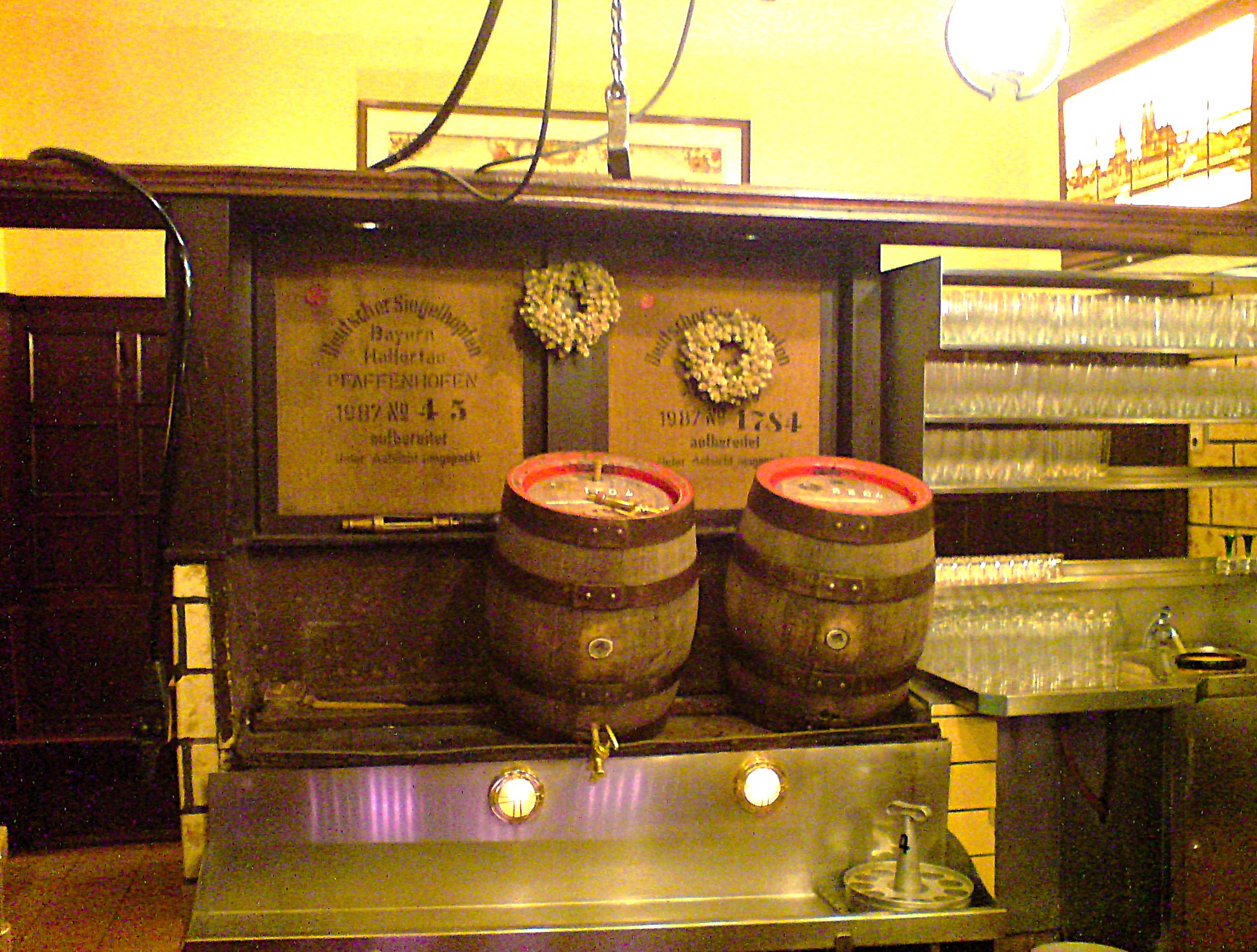
I didn’t plan on waiting 34 years before returning, but in 2009, on an evening out with a few colleagues, whilst attending the Cologne International Dental Show, I was finally able to make that return visit to Päffgen. With a sense of eager anticipation, my colleagues and I pushed open the door, and found ourselves in a central corridor with a small room leading off to the left, and a much larger one to the right. We opted for the latter and were soon seated at one of the many tables in the wood-panelled room. On the way in we noticed two up-ended wooden casks, tapped and ready for serving.

We ordered a Kölsch each and were pleasantly surprised by its hoppy flavour. I had a look round the rest of the pub to see if it would bring back any memories. I recognised the large back room at the end of the corridor as being the place where, on a damp July evening, my friend and I had sat enjoying several glasses of Päffgen Kölsch. It was great to be back, even if the memories were rather vague but sadly, as mentioned previously, I haven’t been back since then, despite several attempts during subsequent visits to IDS.

In May 2017, I made a non-work-related visit to Cologne, along with son Matthew. We were part of a group of beer enthusiasts drawn mainly from Maidstone CAMRA, plus a few neighbouring branches. Our visit to Cologne was a one-day interlude, that occurred during a stay in the neighbouring Rhineland city of Düsseldorf – basically what Americans would call a “side-trip.” The transit time between the two cities is around 35 minutes, so it’s a journey that’s well worth making.

We were in Cologne for a look around, and also to have a tour around a typical Kölsch brewery, in the guise of Brauerei Sünner. Our visit was not scheduled until later in the afternoon, so this gave us plenty of time for a look around Cologne and also to sample some Kölsch. We decided to make for Brauerei zur Malzmühle at Heumarkt; an old established former brewpub at the far end of the Alter Markt. This was a pub I had never managed to get to on previous visits to the city, so I was quite pleased with the opportunity to go there this time around.

Housed in a rather functional-looking building, replacing the original structure, which was destroyed in World War II, Malzmühle was every bit the traditional German beer house on the inside. With high ceilings and plenty of wood panelling, we made for the two tables at the far end of the room. One of the thoughtful waiters came over and fixed a “bridge” in between the two, thereby joining them and enabling us to all sit together.  

Malzmühle Kölsch was quite a bitter variant on the style. Being slightly away from the main tourist areas, Brauerei zur Malzmühle was very much a local’s pub, but we were nevertheless made very welcome. (I think the staff were glad of our presence during what seemed a slack period).

Our day in Cologne concluded with the aforementioned visit to Brauerei Sünner, a traditional brewery on the other side of the River Rhine, and one where the Kölsch style of beer is said to have originated. I’m rather surprised to discover, that I didn’t write anything about the brewery tour, at the time, but despite an extensive search cannot find anything. I did take quite a few photos, though, so you will have to make do with those. 

After our tour around the brewery concluded, we enjoyed an excellent evening meal, served in the small beer garden attached to the brewery. This area open to local residents, as well as visitors to the brewery, as evidenced by the photos, and if you look carefully, you will notice a small keg of Kölsch on one of the tables. A nice idea that saves on trips to the bar or trying to attract the attention of the waiting staff.  

One city centre Kölsch outlet that I visited, during one of my first business trips to Cologne, was Pfaffen. At the time, this was the only outlet for the beer of the same name, and story behind this establishment dates back to a fall out between owner, Max Päffgen, and other members of the Päffgen family. This led to Max starting a brewery of his own. I wrote at the time that the Pfaffen Kölsch served at Max’s pub, was probably the best version of the style I tasted during my stay in Cologne. It was so good that I stayed for several more glasses.

The Pfaffen tavern is a long, narrow building featuring some attractive carved, light-coloured woodwork and also some interesting contemporary stained glass. Regrettably, I haven’t been back since, but with beer that good I brought my colleagues there on our last night in the city, and they were well impressed. The beer was served direct from wooden casks, and such was the demand for this excellent Kölsch that we witnessed the cask being changed twice in less than an hour and saw the row of empties stacked up in the corridor.

I’m not sure as to when I first came across Schreckenskammer-Kölsch. It must have been prior to my penultimate visit to Cologne, which was in 2019. This was at a time when I believed I had drunk virtually every Kölsch available in the city, so stumbling upon Schreckenskammer came as something of a surprise. I bought a 500ml bottle during that 2019 trip but was determined to track down the Schreckenskammer pub on my next visit to Cologne, little thinking that, thanks to Covid, the trip wouldn’t be for another four years!

Situated to the north-west of Cologne’s imposing main rail station, or Hauptbahnhof, the pub was quite easy to find, particularly with the assistance of Google Maps, on my Smart Phone.  

The distinctive looking church tower of St Ursula, acted as my guide as I drew near to the pub. With the original Schreckenskammer beer house destroyed by Allied bombing, in 1943, today’s pub is a modern building, which dates from the 1960’s. It is still quite an attractive looking building, which overlooks a paved area at the entrance to the church. Pleased with myself for having found the place, I gingerly pushed the door open and stepped inside.

There was a small room over to the left, with its own serving counter, complete with some casks of beer, in full view of the customers. There was a handful of customers present, plus a member of staff behind the counter. It looked very much like a private bar,” so I headed, instead, for the larger, and more spacious room to the right. It was laid out with plenty of tables and chairs, but very little in the way of empty places, as most seemed occupied with diners.  I sat myself down at the end of one such table, with my back to the window. I do this in most pubs, as I like to see what’s going on, rather than sit with my back to the action. 

When the waiter, or Kobe, passed, by with his tray of glasses, he uttered the word, “Kölsch,” and almost without waiting for an answer, placed a full glass on the table in front of me, whilst at the same time marking a fresh beer mat, with a tick. The beer was served in a badged glass – as per the photo and was rather good, with a deep golden colour and plenty of body. The pub itself was buzzing, with a lively mix of customers, spanning several different age groups. I got the impression that most of them were local, drawn from the nearby flats.

Finding Schreckenskammer left just one final, classic Cologne pub to tick off my list, and that outlet was the legendary Gaststätte Lommerzheim, which I visited on my final evening in Cologne. Known locally as Lommi’s, this establishment is a “must visit” Cologne institution, and one of those pubs you feel privileged to have experienced. Recommended by a wide assortment of different beer writers, including Matt from Stockport, Retired Martin, and Rob Sterowski, but still far enough off the beaten track to have escaped the notice of the more usual suspects, Lommerzheim is in a class of its own.

Described as a throwback to a bygone era, Lommi’s is a proper community local, catering to a wide age groups and a diverse range of customers. As well as serving one of the best glasses of Kölsch in Cologne - Päffgen, naturally, dispensed from a wooden cask behind the bar counter, the food looks really inviting as well, that’s if you can find space at table where you can sit down and get stuck in. On my visit, shortly after 6pm on a Thursday evening, the place was packed with people were enjoying themselves, either in small groups or conversing with friends and neighbours.

If you want to learn more, then click on the link here, but don’t just take my word for it, add Gaststätte Lommerzheim to your beer-bucket list, or make it an essential part of any visit to Cologne and the Rhineland, (there are some classic pubs in Düsseldorf as well, and like Cologne, the city has its own unique style of beer). If these accounts haven’t whetted your appetite, then I don’t know what will, but I do know I have spent some very happy times in this part of Germany, drank some truly amazing beers and enjoyed them in some equally wonderful pubs.


Monday, 30 March 2009

A Week in Cologne


Visitors to this site will no doubt be aware that I have been in Cologne for the past week, helping to man our company's stand at the International Dental Show. This event, which takes place every two years, is by far the largest such show in the world and for any company involved in the dental industry attendance at IDS is pretty much essential. The company I work for is the UK's leading manufacturer of "Private Label" dental materials and although we are not quite up there with the likes of 3M and Fuji, having a stand at the show is very important to the ongoing success of our business.

Myself and three of my colleagues drove across to Cologne last Monday in order to set the stand up ready for the show's opening the next day. Although the show was open from 9am through to 6pm, there was the opportunity for a fair degree of socialising in the evenings. Whilst some of this involved attending a function with our parent company, a dinner engagement with one of our suppliers, plus a lavish "End of Show" party, we did manage to visit a reasonable number of Cologne's brew-houses and bars, and this is primarily what this article is about.

Before going any further it is worth pointing out that the style of beer most widely available in Cologne is Kolsch, which despite its pale golden colour is actually an ale and not a lager. This is because it is brewed with a top-fermenting yeast, rather than a bottom-fermenting one. It can only be brewed within Cologne itself and its immediate environs . It is served in small, tall, thin glasses that typically hold just 20cl of beer, but these are normally brought to one's table thick and fast by waiters dressed in blue aprons who are known as "Kobes" (an abbreviation of Jacob).

Our first night in Cologne saw us dining in the Sion Brauhaus, a large establishment just off the Alter Markt. Sion Kolsch tasted slightly sweet for my liking, but was pleasant enough all the same. The pub's home-made sausages with fried potatoes and creamy cabbage also slipped down well.

The next evening saw us visiting another Kolsch establishment, this time Gaffel am Dom. This huge, cavernous establishment lies close to both Cologne's famous cathedral, or Dom, and the imposing Hauptbahnhof or main station. Gaffel's brewery is also close by and I found its hoppier Kolsch rather more to my liking. The large Schnitzel I ate at the pub was also very good, but left precious little room for more beer drinking. However, two of my colleagues persuaded me that a night-cap or two would be a good idea so we headed off into the Alter Markt and ended up in a bar called "Papa Joe's". From the outside this looked the sort of place I would not normally frequent, however, once inside I was pleasantly surprised. A pianist was bashing away at an old fashioned piano, and when she had finished a mechanical wax-works dummy, played a tune on the accordion. The place was heaving and it was all very jolly. We found that as well as Kolsch, Papa Joe's had Konig Pilsener on tap. This beer is the sole offering from the huge brewery of the same name in Duisburg. It made a pleasant change from Kolsch though, and being served in 40cl glasses meant less time waiting at the bar to be served.

Wednesday evening saw us dining at a Spanish restaurant with a party from one of our main suppliers. Fish featured prominently on the menu and was both well-cooked and well-presented. I had several glasses of Veltins Pilsener to wash my meal down, much preferring this to the San Miguel which was the other beer on offer. We left the restaurant just before 10pm and said farewell to our guests. The fact that we were slightly to the west of the town centre gave me the opportunity to lead my colleagues to a superb Kolsch establishment that I had first visited over 30 years ago.

Brauerei Paffgen is a place that is well-known to beer lovers; not only is its wonderfully hoppy Kolsch brewed at the rear of the premises, but it is also dispensed from wooden casks. A former school friend had taken me to Paffgen during my first visit to Cologne, way back in 1975. My friend was working in the city as part of the language degree he was taking. I was also a student, but at the time was travelling around Europe, by train, on an Inter-Rail ticket with a friend from university. I had parted company from my travelling companion in Hamburg; he had travelled on to Stuttgart to spend a few days with his then girlfriend, whilst I had made the shorter journey to Cologne. The plan was that we would meet up later in the week in Stuttgart and continue with our journey on into southern Europe. Even back then I had a reputation for enjoying good beer so my host, knowing this fact, had taken me to Paffgen as he knew I would be impressed.

This was certainly the case; pubs that brewed their own beer in England were as rare as hens teeth back in the 70's, so Paffgen was certainly a novelty as far as I was concerned. I had always wanted to make a return visit, but never realised it would take me 34 years before the opportunity to do so would arise. This was something I was going to enjoy and was an occasion I would not have missed for the world.

It was with a sense of eager anticipation that I pushed through the door to Paffgen's legendary establishment. There was a central corridor with a small room leading off to the left, and a much larger one to the right. We opted for the latter, and were soon seated at one of the many tables in the wood-paneled room. On the way in we noticed two up-ended wooden casks, tapped and ready for serving. We ordered a Kolsch each and were pleasantly surprised by its hoppy flavour. I had a look round the rest of the pub to see if it would bring back any memories. I recognised the large back room at the end of the corridor as being the place where my friend and I had sat that damp July evening all those years ago. It was great to be back there, even if the memories were rather vague. We enjoyed several more glasses of Paffgen's Kolsch before walking back to our hotel; it had been a long-overdue return and I hope not to leave it that long again before my next visit.

The next two evenings were taken up with a corporate dinner at the Hyatt Regency, where Sion Kolsch was on tap, plus a lavish end of show party held at a massive, converted former engineering workshop called "Die Halle", on the outskirts of Cologne. Gaffel Kolsch was on tap here, and we consumed more than our fair share of it.

Having manned the stand for the five day duration of the show, we were each allocated a free afternoon. My allotted spot fell on a very wet Thursday afternoon. Despite having the corporate dinner to attend that evening, I was determined to visit a few of Cologne's Kolsch houses but without getting too"tanked up" in the process.

My first port of call was the famous Fruh am Dom, a large establishment in the shadow of the Dom. It wasn't exactly heaving inside, and I had no difficulty in locating a table. On my way in I had witnessed the beer being dispensed from a large wooden cask. On reflection, and certainly compared to the casks I had seen in both Paffgen and Pfaffen, this cask looked far too shiny and new to have been used for the transport of beer from the brewery. I suspect therefore that it was purely for show, and that the beer was fed to it via a hidden pipe. Nevertheless Fruh Kolsch was pleasantly hoppy and eminently drinkable.

I moved on as I wanted to visit a place called Pfaffen, which is the only outlet for the beer of the same name. There is a story behind this establishment in so much that it's owner, Max Paffgen fell out with some of the other members of the family and decided to start a brewery of his own. The Pfaffen kolsch was probably the best version of the style that I tasted during my stay in Cologne; in fact it was so good that I stayed for several more glasses. The long, narrow building features some attractive carved, light-coloured wood-work and also some interesting contemporary stained glass. I brought my colleagues here on the last night of our stay and they were well impressed. The beer is served direct from wooden casks, and such was the demand for this excellent kolsch that we witnessed the cask being changed twice in less than an hour, and saw the row of empties stacked up in the corridor.

So there we have it, Cologne in a nut shell. Given the fact that I was there on business, I still managed to see and sample a fair bit of the city. The Dental Show itself is a hugely important event for Cologne. This year there were over 1,700 exhibitors; some relatively small like ourselves, others massive international companies with the large entourage necessary to man their stands. There was a real buzz just walking about in the city at night, and all the bars and restaurants, as well as the local taxi companies, were doing a roaring trade. Although I had been to Cologne a couple of times before, I felt I really got to know it on this visit. It is a lively, vibrant and friendly city with some great places to eat and drink. I am already looking forward to a return there in two years time!

Tuesday, 25 March 2025

A few reflections looking back with fondness, at Cologne

A couple of posts ago I mentioned my plan to reflect on some of the more notable establishments in Cologne where one can enjoy quality food, free-flowing beer, engaging conversation and a relaxing atmosphere. That was the plan, but the more I’ve looked into it, the more taxing the task has become. Over the course of eight separate visits to Cologne, I've got to know many of the city’s best drinking houses. I did a count up and can list 12 classic beer houses selling Kölsch in the city, plus a number of “also runs”, and that’s without really trying. It's a start though, especially as I’ve had personal experience of all these establishments, but before describing some of them it’s worth reminding ourselves of what Cologne’s unique beer style is all about.

Kölsch is a survivor from the pre-lager brewing tradition of Northern Germany, but over the years has undergone a good deal of change. The most notable of these is the lightening of its colour to pale yellow, giving it the appearance of a Pilsner. It is perhaps not surprising then to learn that it is brewed mainly from Pilsner malt. Kölsch is top fermented at a temperature of between 13 to 21°C, which is more typical of ale brewing, but after the initial fermentation, it undergoes a period of conditioning, where it is lagered at a much colder temperature.

The end result is a clear beer with a bright, straw-yellow hue, but considering its background, there is little ale character to be found, apart from a little fruitiness. Kölsch tends to have a soft, and well-rounded character and can sometimes be on the sweet side.

Kölsch has to be brewed in the Cologne area before it can call itself such, and this qualification is stipulated by the “Kölsch Convention”, which dates back to the 1980’s. The convention was drawn up 24 breweries, some of which are no longer brewing, in order to protect the style from outside imitations. Additionally, a beer may only be called a Kölsch if it meets the following criteria:

It is brewed in the Cologne metropolitan area:

It is pale in colour
It is top-fermented
It is hop-accented
It is filtered
It is a ‘Vollbier’

Kölsch is usually served in small, plain cylindrical glasses known as Stangen, which typically hold just 20 cl of beer, although some outlets will use 25 cl versions. The reason for the small glasses is Kölsch is a beer designed to be drunk fresh. Leaving a newly poured glass standing for any length of time allows the beer’s condition to dissipate and is not conducive to enjoying it at its best. This ensures that customers have a fresh glass of beer for as long as they wish to continue drinking,

Kölsch waiters, who appear to always be male, carry round a circular tray known as a Kranz. This has inserts designed to accommodate up to a dozen glasses, and they will automatically offer customers a fresh glass of Kölsch, making a pencil mark on a beer mat, for each glass taken. The waiters are known as “Köbes” (a word derived from “Jakobus”) and wear distinctive blue aprons. They have a reputation for being a bit gruff, but this might be unfounded, as most of the ones I have come across have been helpful and often friendly as well.

Since the formation of the
“Kölsch Convention”, there has been the inevitable mergers and closures, so typical of the brewing industry the world over. This has led to many Kölsch “brands” now being brewed at one large brewery, known as the Kölner Verbund Brauereien GmbH & Co. This is housed in what was formerly the Küppers Brewery.

So, what about the pubs and bars? Personally, I prefer some of the less well-known establishments away from the well-worn tourist trail. But if you’re a stranger to the city, it’s probably advisable to start with some of the more popular establishments and tourist spots, as they offer a good introduction to drinking in Cologne.

One of the most famous Kӧlsch houses in Cologne, as well as one of the largest, is Früh am Dom. "Dom" is the German word for cathedral, and Früh is very close to the magnificent gothic cathedral that dominates the centre of Cologne. 

 I have made several visits to Früh am Dom, and on each occasion this Cologne institution, with its maze of inter-connected rooms, spread out across several different levels, seems to have grown in size. On my last visit to IDS, our group called in at Früh and found the place absolutely heaving. Fortunately, one of the waiters managed to squeeze us in, and looked after our table of six, along with several others. He kept us supplied with numerous glasses of Kölsch that evening and took care of our food orders as well.

Gaffel am Dom, is another large, and cavernous establishment which is on the other side of the cathedral, and just around the corner from the main station (Hauptbahnhof).  It is a beer-hall I know well from numerous visits trips to Cologne, and the Gaffel Kölsch sold is a soft, hoppy, and easy-drinking beer which slips down rather easily. It is also one of the most widely available brands of Kölsch, in Cologne.

Probably my favourite beer house in the city centre is Peter’s Brauhaus, and another establishment that I’ve visited several times. One of the most memorable of these occasions was in 2017, when we called in on what was our second night in the city. Peter’s is a very traditional looking establishment, and the Peters Kӧlsch we enjoyed there was amongst the best we came across during our stay. Even better it was served direct from small metal casks, perched up on a stand behind the bar. Being dispensed by gravity, without the use of extraneous CO2, the beer was smooth tasty and far less gassy compared to what is often the case in Cologne.

Bierhaus en d'r Salzgass, is another classic old town pub, sited on a narrow cobbled street which leads from Heumarkt to Buttermarkt, in an area teeming with pubs, bars and restaurants. I was recommended to try this outlet, by Manchester-based blogger Matt whose informed and well-written site, “When My Feet go Through the Door”, is well worth clicking onto. Matt assured me that, as well as serving Päffgen Kölsch, the pub’s menu was also of a high standard. Two years after that visit to Peter’s, we tried our luck with Bierhaus en d'r Salzgass, after being turned away from a number of other outlets that evening.

As the German speaker of the group, I was left to ask if the pub could accommodate our party of five. The place seemed packed, but the waiter, perhaps warming to being addressed in his native tongue, managed to find us a table squeezed in towards the back of the pub. He also confirmed that we could also pay by card, provided we paid as a group. It was a good move befriending that particular Köbes, as he looked after us well, ensuring we never had an empty glass in front of us, and that our food arrived promptly. I made sure to give him a generous tip when it came to paying the bill.

The Kölsch, which was dispensed straight from the cask was every bit as good as I remembered it, and the food was equally good. Eschewing the rather obvious roast pork knuckle, I opted instead for an old favourite from visits to Munich, in the form of Leberkässe mit Spiegelei & Bratkartoffeln. We spent a couple of hours in this real old-school, traditional pub, soaking up the atmosphere and the beer in equal quantities. I had to accompany the Köbes to the bar, in order to pay, and it was here that I saw the kegs of Päffgen, set out on the counter in a very similar manner to those at Peters Brauhaus.

Päffgen Kӧlsch is worthy of an article of its own, which I will post another time, but not being able to make that third, and probably final visit to this legendary brewpub, remains my sole regret of turning down this year’s visit to IDS. Of course, there’s no guarantee that I would have been able to call in at Päffgen, having been thwarted by circumstances during the last three trips to Cologne, but I regard it as a “special place” and somewhere I’d like to experience one last time. We shall see!